This one comes up more than any other Calendly question I get. A coach sets up a paid session in Calendly, went to connect Stripe, and were told payments need a paid plan. Is $10 a month worth it, or is there a free way round it? That question is the real story behind Calendly pricing, and the answer decides whether you spend $0 or $120 a year.
Most coaches don’t outgrow Calendly’s free plan because of calendars. They outgrow it the day they want a client to pay before the call. This guide walks through the pricing page plan by plan, in plain English: who each plan is really for, and what the catch is. Then I’ll say which plan fits which kind of coach, and when to skip Calendly altogether.
Quick context on me. I’m not a coach. My work is on the vendor side, helping SaaS companies decide what goes in which plan. So I read these pages looking for the fence.
The fence on Calendly’s pricing page is money, not meetings
Every SaaS pricing page has one feature that does most of the selling. It sits on the paid plan, it looks small, and it’s the thing a growing customer can’t live without. On Calendly, for a coach, that feature is taking payment through Stripe or PayPal at the moment of booking.
You can’t do it on the free plan. You need a paid plan. Everything else on the page matters less to a solo coach than this one line.
Here is why that matters so much. A free discovery call can stay free forever. But a paid session booked without payment means you are chasing invoices, and a client who hasn’t paid is a client who is more likely to skip.
Stay on Calendly Free for discovery calls; pay for Standard only when clients pay you at booking.
- Only free discovery calls → Calendly Free is enough
- Paid sessions, solo practice → Standard, billed yearly
- Packages, contracts and a client portal → neither; look at Acuity Standard ($27/mo) or Paperbell ($970/yr)
Calendly pricing in one table
Before we go plan by plan, here is the whole page reduced to what a coach needs to see. We pull these numbers straight from the vendor pricing page and re-check them monthly.
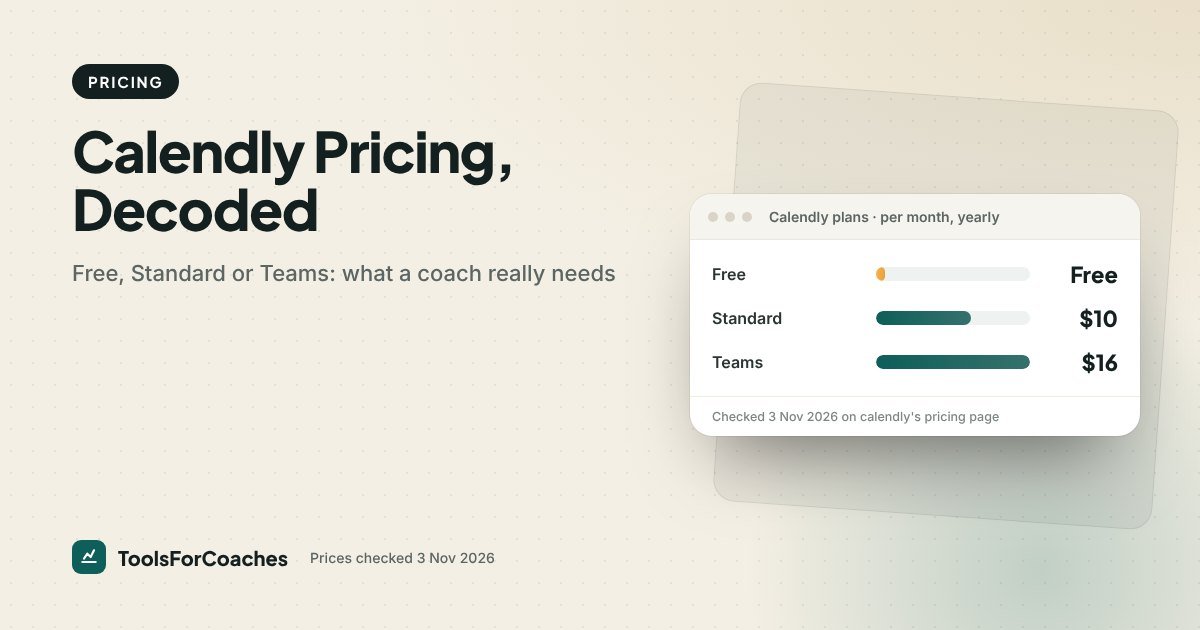
| Plan | Yearly billing | Monthly billing | Take payment at booking? | Really for |
|---|---|---|---|---|
| Free | $0 | $0 | No | Discovery calls only |
| Standard | $10/seat/mo | $12/seat/mo | Yes | Solo coaches who charge per session |
| Teams | $16/seat/mo | $20/seat/mo | Yes | Practices with two or more coaches |
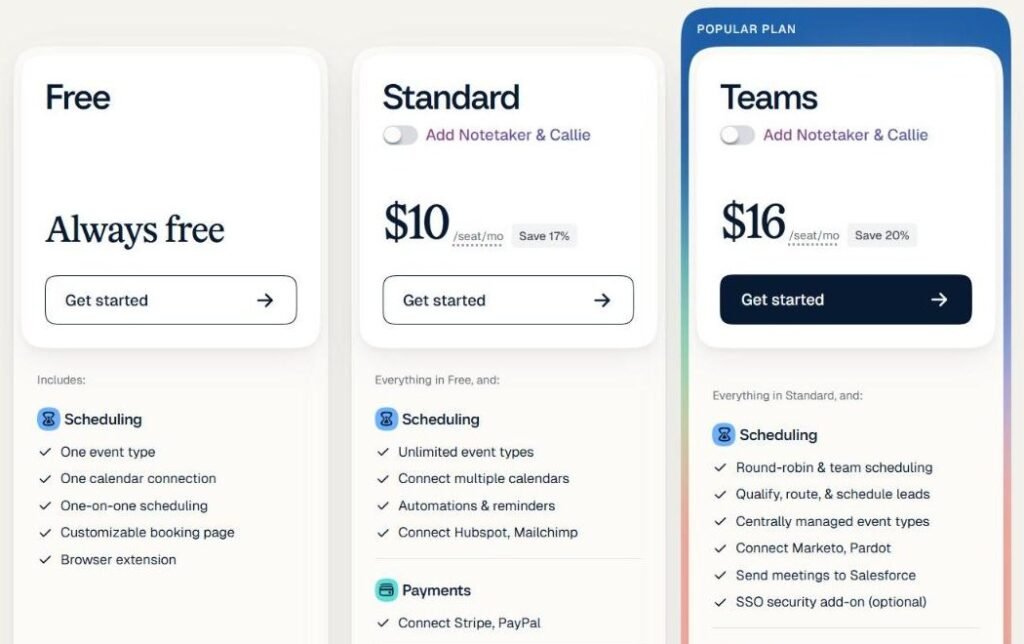
Two words on that table do a lot of work: “per seat”. Calendly charges per person who has a booking calendar, not per business. For a solo coach, that’s one seat. Add an assistant who needs their own calendar, and the bill doubles.
Free: really for the coach who doesn’t charge yet
The free plan gives you a booking link, connects to your calendar, and stops double bookings. For a lot of new coaches that’s the whole job. Someone clicks your link, picks a slot, and it lands in your calendar.
Who the free plan is really for
- Coaches who only book free discovery or “chemistry” calls.
- Coaches who get paid outside the booking, like on a monthly retainer billed by invoice.
- Anyone testing whether a booking link gets clicks at all before spending money.
The catch
No payments at booking. That’s the big one. The free plan is also tighter on event types than the paid ones (check the vendor page for the current limit), so running “discovery call”, “single session” and “package check-in” as separate links gets awkward fast. You’ll also see Calendly branding on your booking page.
If you’re happy with one kind of meeting and no money changing hands, none of this hurts. The moment you want a second paid service, it starts to pinch.
Standard: really for the solo coach who sells sessions
Standard is $10 a month per seat when billed yearly, or $12 if you pay month to month. For one coach, that’s $120 a year on yearly billing, or $144 on monthly. The $24 gap isn’t huge. If you already know you’ll keep Calendly for a year, take the yearly price.
What you’re really buying is the payment link. Clients pick a time and pay by card or PayPal in the same step. No invoice, no “I’ll send it later”, no awkward follow-up.
Who Standard is really for
- Coaches who sell single sessions or paid intensives.
- Coaches who want to charge a deposit or full fee to cut no-shows.
- Anyone running more than one type of booking (free intro plus paid session).
The catch
Calendly takes payment for one booking at a time. It isn’t built to sell a six-session package, track how many sessions a client has left, or send a contract to sign first. You can bolt those on with other tools, but then you’re paying for Calendly plus the bolts.
Also remember the processing fee. Stripe or PayPal take about 2.9% + 30¢ on each payment, on top of the plan. On a $150 session, that’s roughly $4.65. Calendly doesn’t set that fee and no scheduler avoids it, but it belongs in your sums.
The coach who pays for Standard six months too late
The coaches who write to me about this have usually run a paid practice on the free plan for months. They book paid sessions through the Calendly link, then send a PayPal request by hand after each booking. It feels fine. It costs nothing.
Put their calendar next to their PayPal emails and the split is obvious. Clients who paid upfront almost always showed. The ones who booked and “would pay after” rescheduled twice, then vanished. And part of every Sunday went on matching payments to calendar entries. After the switch to Standard, the $120 a year tends to come back the first time a paid client doesn’t ghost them. They’d been saving $10 a month to do a job they hate.
The rule I’d use: if even one booking a month is paid, the free plan is costing you more than $10 in time and no-shows. Upgrade, or move to a free tool that takes payments.
Teams: really for a practice, not a person
Teams costs $16 per seat per month on yearly billing, or $20 monthly. For two coaches on yearly billing, that’s $32 a month, or $384 a year. It adds the tools a group needs: sharing bookings across people, routing a client to the right coach, and admin controls.
Who Teams is really for
- A small coaching firm with two or more coaches who share clients.
- A coach with an associate who takes overflow sessions.
- Anyone who needs “book with whoever is free” round-robin links.
The catch
Solo coaches get almost nothing from Teams. People often pick it because it sounds more “serious”. If you’re the only person taking calls, Standard covers what you need for $6 less per month on yearly billing. That’s $72 a year for features you won’t touch.
Above Teams there’s a sales-led tier for large companies. No solo coach needs it, so I’ll leave it there.
The costs that sit outside Calendly pricing
Calendly pricing covers the plan. The plan price is the number you see. It’s rarely the number you pay. When coaches add up what their booking setup really costs, the same three extra lines keep showing up.
1. Card processing on every paid booking
We covered this above, but it’s worth putting in yearly terms. If you take 10 paid sessions a month at $150, Stripe or PayPal keep about $4.65 a session. That’s around $46 a month, or roughly $558 a year. It’s far more than the Standard plan itself. It isn’t a reason to avoid Calendly, since every tool has it. It’s a reason not to obsess over a $2 plan difference while ignoring the bigger line.
2. The tools you bolt on to fill the gaps
Calendly books and charges. It doesn’t send contracts, track package sessions, or keep client notes. Coaches usually fill those gaps with a contract tool, a CRM or a Zapier plan. Zapier’s Professional plan starts from $19.99 a month on yearly billing, which on its own is double Calendly Standard. Our guide to Zapier for coaches shows which automations are worth it.
3. The extra seat you didn’t plan for
Per-seat pricing is quiet until it isn’t. Bring on a virtual assistant who books calls on your behalf with their own calendar, and Standard goes from $120 to $240 a year. If they only manage your calendar, check whether they need a seat at all before you add one.
None of this makes Calendly expensive. It makes “$10 a month” an incomplete answer. Add up the real stack before you compare it with an all-in-one tool.
Yearly or monthly Calendly pricing: the small decision that adds up
Calendly, like most scheduling tools, gives a better rate for paying a year upfront. Here’s what one seat costs over twelve months.
My view: pay monthly for the first two or three months while you test whether clients actually use the payment step. Once they do, switch to yearly. The extra few dollars are cheap insurance against locking in a tool that doesn’t fit.
What Calendly pricing looks like next to the alternatives
Calendly is the name everyone knows, so its pricing becomes the yardstick. But on the exact feature that forces the upgrade, it isn’t the cheapest option any more. Here’s how its paid entry point compares with the other tools coaches ask us about most.
| Tool | Cheapest way to take payment at booking | Free plan? | Where it wins |
|---|---|---|---|
| Calendly Standard | $10/mo yearly | Yes, no payments | Familiar, clean booking page clients trust |
| Cal.com | $0 | Yes, payments included | Free payments, unlimited event types |
| TidyCal | $0 | Yes, paid and package bookings included | Packages on a free plan; $29 one-time upgrade |
| Acuity Starter | $16/mo yearly | No, 7-day trial | Intake forms and a fuller “front desk”; packages from Standard ($27) |
| Paperbell | $80.83/mo yearly ($970/yr) | No (30-day money-back guarantee) | Packages, contracts and client portal in one |
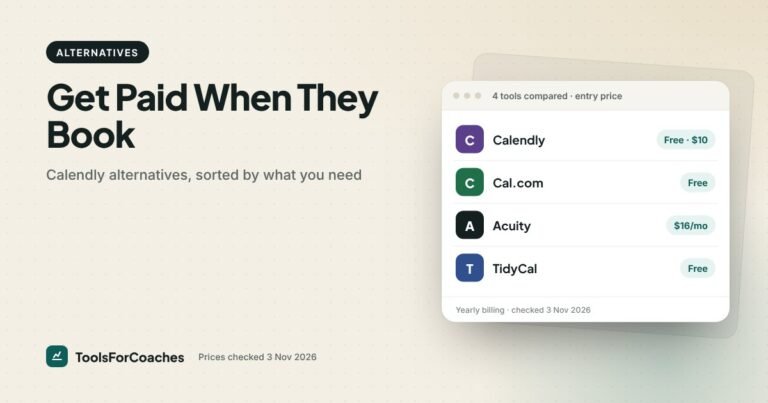
The awkward fact for Calendly: since October 2026, Cal.com’s free plan includes built-in payments. TidyCal’s free plan takes paid bookings too. If your only reason to pay Calendly is to get paid at booking, there are now $0 ways to do that. We dig into the trade-offs in Cal.com vs Calendly.
Where Calendly still wins: it’s the tool most of your clients have already used. The booking page is simple and familiar. Setup takes minutes. For some coaches, a client who has booked a hundred Calendly links before and trusts the page is worth $10 a month.
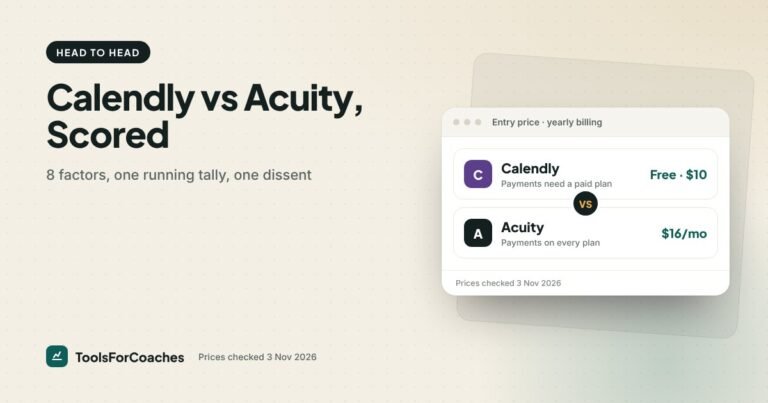
And if you need intake forms and packages, compare Calendly vs Acuity first. Acuity costs more per month but does more of the front-desk work.
Which Calendly plan fits which kind of coach
Here’s how I’d decide, by the kind of practice you run.
The new coach still doing free calls
Stay on Free. Spend your money on getting people to the link, not on the link itself. Come back to this page when your first paid client books.
The solo coach selling single sessions
Standard, billed yearly once you’re sure. $120 a year to get paid at booking and offer several event types is fair. If $120 matters right now, try Cal.com’s free plan first and see if you miss anything.
The coach who sells packages
Think twice about Calendly at any tier. You’ll end up paying for Standard plus a contract tool plus something to track sessions used. Acuity Standard ($27 a month yearly) sells packages natively, and TidyCal’s free plan takes package bookings. A coaching-specific tool like Paperbell adds contracts and a portal too, but at $970 a year with no free plan, it suits a steady roster more than a first package. Our Paperbell review covers who it’s wrong for, too.
The small firm with two or more coaches
Teams, billed yearly. Round-robin and shared booking pages are what you’re paying for. Do the seat maths before you add part-time associates, because each one is another $16 a month.
Who should not pay for Calendly at all
- Coaches who never take payment at booking. Free does the job.
- Coaches on a tight budget who are fine learning a slightly newer tool. Cal.com does payments for $0.
- Coaches whose real problem is admin, not scheduling. You need a client-management tool, not a nicer calendar.
What I’d do with $120 a year
If you’re a solo coach who charges per session and you like Calendly, pay for Standard yearly and stop thinking about it. It’s a fair price for what you get, and the no-shows it prevents will pay for it.
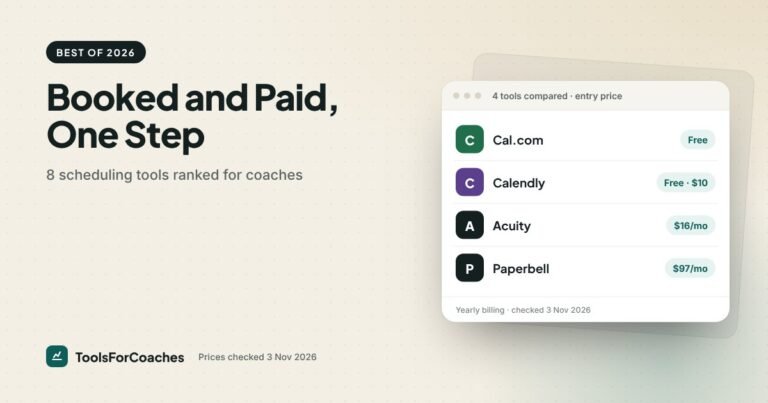
If you haven’t picked a scheduler yet, I’d start on Cal.com’s free plan with payments switched on. If you find yourself missing Calendly’s polish after a month, the upgrade is $10 away. For the full field, see our ranked list of the best scheduling software for coaches and the best free scheduling apps.
Calendly pricing questions coaches ask
Is Calendly free for coaches?
Yes, Calendly has a free plan at $0. It handles booking links and calendar sync, which is enough for free discovery calls. It doesn’t let clients pay at booking, so most coaches who charge per session end up on a paid plan.
How much does Calendly cost per month?
Standard is $10 per seat per month billed yearly, or $12 billed monthly. Teams is $16 per seat yearly, or $20 monthly. Prices checked 3 Nov 2026 on Calendly’s pricing page.
Can I take payments on Calendly’s free plan?
No. Collecting payments through Stripe or PayPal needs a paid plan, which starts with Standard. If you want payments at $0, Cal.com’s free plan includes built-in payments as of October 2026.
Does Calendly charge a fee on payments?
Your payment processor does. Stripe and PayPal take about 2.9% + 30¢ per sale. That fee applies with any scheduler, so compare tools on plan price and features, not on processing.
Is Calendly worth it for a solo coach?
Standard is worth it if you charge for sessions and want payment at booking. It’s not worth it if you only run free calls, or if you sell packages and need contracts, in which case a coaching-specific tool fits better.
Should I pick Calendly Standard or Teams?
Standard, if you’re the only person taking bookings. Teams adds shared and round-robin booking for groups, which a solo coach won’t use. On yearly billing, Teams costs $72 more per seat per year.