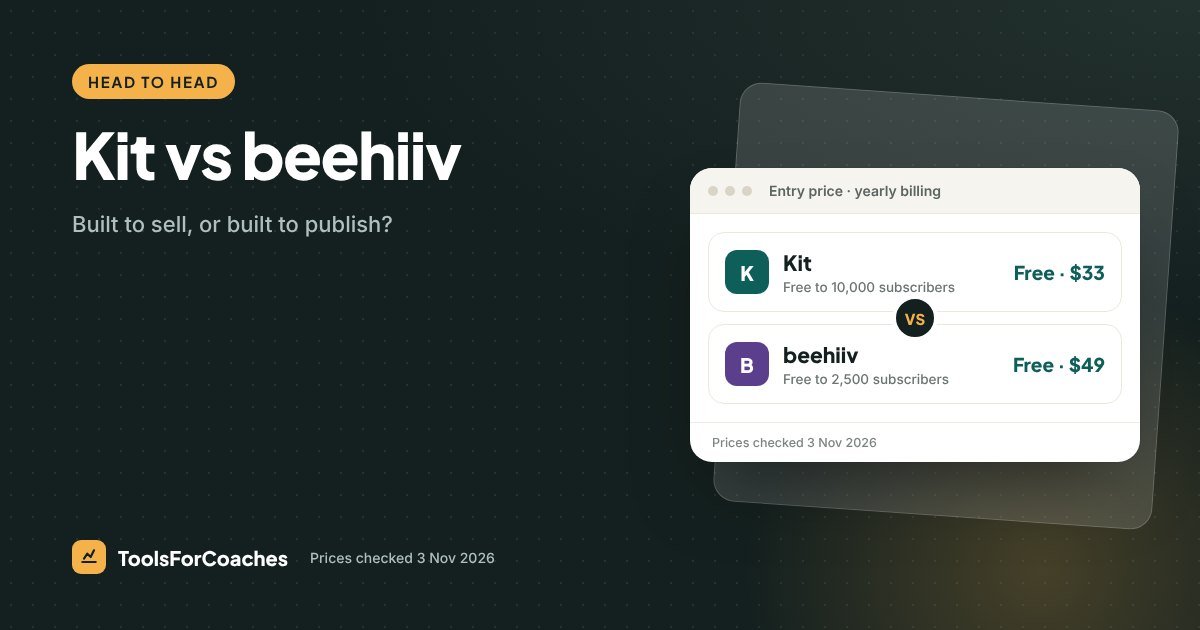
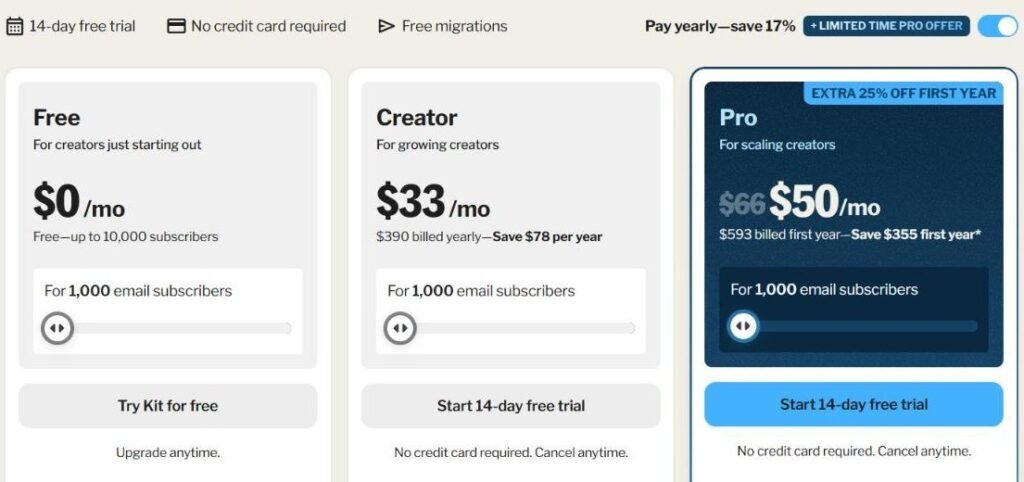
$390 a year against $588. That’s Kit Creator next to beehiiv Lite at 1,000 subscribers, both on yearly billing, and it’s the first surprise in Kit vs beehiiv: the tool with the “cheap newsletter” reputation costs $198 more at the smallest paid tier. Price still shouldn’t decide it. Pick Kit if your emails exist to fill a coaching program. Pick beehiiv if the newsletter is the product people come for. For most coaches, that’s the whole answer.
The longer version matters because both tools now have free plans that look generous, both changed how they price, and the one that’s “cheaper” flips depending on your list size and what you need. I pulled both pricing pages on 3 Nov 2026 and ran the numbers for the two most common kinds of coaching business. Here’s what came out.
Kit wins for coaches who sell through email; beehiiv wins for coaches who publish
- You sell 1-to-1 packages or a group program and want a welcome series that books calls → Kit
- You write a weekly letter, want referrals and sponsors, and sell coaching on the side → beehiiv
- You have under a few hundred subscribers and one offer → stay on Kit’s Free plan and don’t pay anyone yet
The real split: sending a sale vs publishing an issue
People compare these two like they’re the same kind of tool. They aren’t. They overlap on “send an email to a list”, and then they head in different directions.
Kit (the company formerly called ConvertKit) is built around the subscriber. Who joined, what they clicked, which tag they carry, which sequence they’re in. Every feature points at one job: move a person from “downloaded your free guide” to “bought your program”.
beehiiv is built around the issue. The post, the web archive, the growth loop. Its standout tools are a referral program, boosts and an ad network. Those help a newsletter get bigger and earn from sponsors. Its automations exist, but they’re less deep than Kit’s.
So the Kit vs beehiiv question isn’t “which is better”. It’s “which job does your email do?” Most coaches never ask that out loud.
Coach type 1: filling a 12-week group program
The first kind is a career coach who runs a group program a few times a year and fills it from her email list. The list is just under 1,000 people, mostly from a free “salary negotiation script” download.
What that email needs to do:
- Deliver the free script the moment someone signs up.
- Run a welcome series that tells her story and ends with a discovery call link.
- Tag people who click the program page, so she can email only the warm ones at launch.
- Stop sending the sales emails to anyone who already bought.
That last point is the one a newsletter-style setup misses. Start on a tool because it’s free and looks nice, and at launch the people who already paid can get the “doors close tonight” email. Of all the launch mistakes coaches describe to me, this one stings most, usually because a buyer replies asking if they’ve been charged twice.
That’s an automation problem, not a writing problem. Kit handles it with tags and rules: buyer gets tagged, buyer leaves the sales sequence. It’s the kind of thing Kit was made for.
The fit: Kit Creator at the 1,000-subscriber tier, $33/mo on yearly billing. This coach needs more than the one sequence the free plan allows, and the app integrations so her checkout can tag buyers.
Coach type 2: a Sunday letter for founders
The second kind is a leadership coach whose real engine is a Sunday newsletter about managing your first team. People forward it. He has a little under 2,500 readers and wants more. He sells coaching, but only through a short line at the bottom of each issue and a page on his site.
What that email needs to do:
- Look good as an issue and live on a web archive people can find.
- Reward readers who share it, so growth doesn’t depend on him posting on social.
- Maybe, later, carry a sponsor.
- Send one simple welcome email. That’s about it for automation.
He doesn’t need branching sequences. He needs a growth loop. beehiiv’s referral program and boosts are aimed squarely at him, and the Free plan costs $0 up to 2,500 subscribers.
The fit: beehiiv. Start on Free, then move to Lite when he outgrows it or wants sponsors, paid subscriptions or automations.
Kit vs beehiiv cost at the list sizes coaches actually have
Here’s what each tool costs at the tiers both companies publish. I’ve used yearly billing because that’s how most coaches should pay once they’re sure, and shown monthly billing where we’ve confirmed it.
| Plan | Subscribers | Yearly billing (per month) | Monthly billing | What you’re paying for |
|---|---|---|---|---|
| Kit Free | Up to 10,000 | $0 | $0 | 1 automation, 1 sequence, Kit branding, no app integrations |
| beehiiv Free | Up to 2,500 | $0 | $0 | Free newsletter publishing |
| Kit Creator | 1,000 | $33 | $39 | Full sequences, automations, integrations |
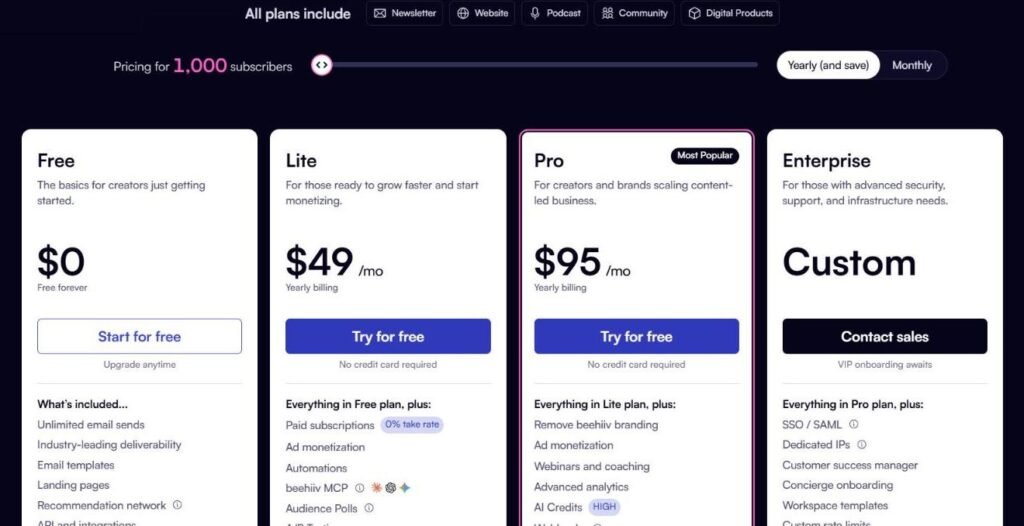
| beehiiv Lite | 1,000 | $49 | Check page | Paid subscriptions (0% take), ad monetisation, automations |
| Kit Pro | 1,000 | ≈ $66 | $79 | Creator plus advanced features |
| beehiiv Pro | 1,000 | $95 | Check page | Lite plus no beehiiv branding, webinars, advanced analytics |
| Kit Creator | 5,000 | $65.83 | $79 | Same features, bigger list |
| Kit Creator | 10,000 | $92.50 | $111 | Same features, bigger list |
Two things jump out about Kit vs beehiiv on price.
First, the gap from the top of this page. At 1,000 subscribers, Kit Creator is cheaper than beehiiv Lite: $33 against $49 a month on yearly billing, or $390 against $588 over a year. Not a fortune, but it runs the opposite way to what most people assume.
Second, the free plans are shaped very differently. Kit lets you hold up to 10,000 subscribers for free, but caps you at one automation and one sequence. beehiiv’s free plan stops at 2,500 subscribers. So Kit’s free plan is wide and shallow. beehiiv’s is narrower on list size.
One note on the gaps in that table. Kit publishes prices at set list sizes, and beehiiv’s paid prices move with your list. I’ve only listed the tiers we could confirm. If you sit between tiers, open the slider on each pricing page and plug in your own number. Or use our cost calculator to see it next to the rest of your stack.
Don’t forget: neither tool takes the payment for your coaching. That happens in Stripe, PayPal or your course platform, at roughly 2.9% + 30¢ per sale. Email cost is separate from that.
Where Kit wins for coaches
Sequences that behave like a sales assistant
This is the big one. A coach’s welcome series is usually doing real work: building trust, telling a story, and asking for a call. Kit’s sequences and visual automations let you branch on what people do. Clicked the program link? Move them to the warm list. Bought? Pull them out of the sales emails.
The “doors close tonight” email to buyers is exactly what this fixes.
Tags as a memory of your reader
Coaches often serve two or three types of people. A health coach might have new mums and busy executives on the same list. Kit’s tagging lets you remember who’s who and send each group the right offer. On a list of a few hundred, that can be the difference between a launch that fills and one that fizzles.
Integrations with the tools that take money
Kit’s paid plans connect to checkouts, course platforms and scheduling apps, so a sale or a booking can change what someone gets next. Note that the Free plan has no app integrations. That’s usually the moment a selling coach upgrades. We cover that trigger in detail in our Kit pricing breakdown.
Cheaper at the smallest paid tier
$33 vs $49 at 1,000 subscribers on yearly billing. If you need paid features at a small list size, Kit costs less.
Where beehiiv wins for coaches
Growth that doesn’t depend on your Instagram
beehiiv’s referral program rewards readers for sharing. Boosts let other newsletters recommend yours. For a coach like the Sunday-letter writer, whose newsletter is the shop window, that’s a growth engine Kit doesn’t match in the same way.
A newsletter that earns on its own
beehiiv’s ad network can put sponsors in your issues, and Lite also lets you sell a paid edition with 0% taken by beehiiv. Most coaches won’t care. But a coach with a big, focused audience (say, first-time managers or new founders) might find sponsors cover the software and then some.
A free plan shaped for writers
Kit’s free plan holds more people: 10,000 against 2,500. But its limits sit on the selling side, with one automation and one sequence. beehiiv’s free plan limits you on list size instead, and leaves the publishing side as the focus. A writer who sends a weekly issue won’t miss deep automations, though beehiiv’s automations start on Lite, so check what your welcome email needs. For that coach, beehiiv’s free plan fits the job better, even though the number is smaller.
Publishing feels like publishing
If you think of your emails as “issues” with a web archive, beehiiv’s editor and site are built for that mindset. Kit can do it, but beehiiv leans into it.
- Deeper sequences and automations
- Tags and rules that stop you emailing buyers a sales pitch
- Free plan holds up to 10,000 subscribers
- $33/mo vs $49/mo at 1,000 subscribers (yearly)
- Referral program and boosts for organic growth
- Ad network for sponsor income
- Publishing-first editor and web archive
- Free up to 2,500 subscribers for a simple newsletter
The free plans: which one lets a coach go further at $0?
The two free plans are built so differently that this deserves a straight answer.
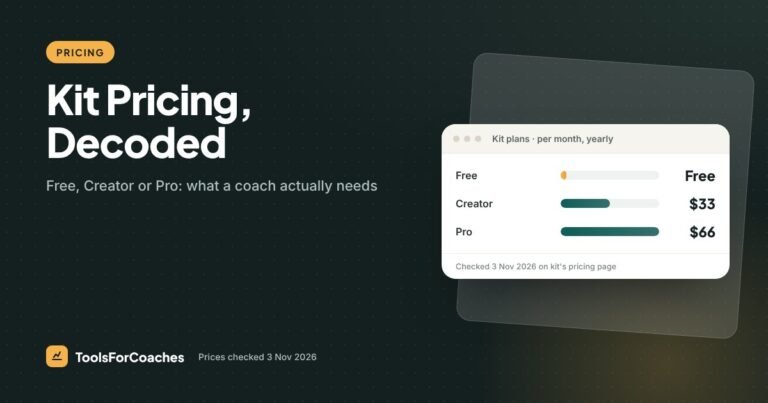
Kit’s Free plan costs $0 up to 10,000 subscribers. You get one automation and one sequence. You carry Kit branding. You get no app integrations.
In practice that means you can do this for free on Kit:
- Collect sign-ups for one lead magnet.
- Send a single welcome sequence.
- Send weekly broadcasts to everyone.
What you can’t do: run a second funnel, tag buyers from your checkout automatically, or connect your scheduling tool. The day you launch a second offer, you’ll feel the wall.
beehiiv’s Free plan costs $0 up to 2,500 subscribers. It’s aimed at people starting a newsletter. If your plan is “write every week and grow”, it carries you a long way. When you need automations, ad money or paid subscriptions, or you pass 2,500 subscribers, you move to Lite. Check beehiiv’s pricing page for exactly which features sit on which plan, since that list changes.
My take: a brand-new coach with one offer should start on Kit’s free plan. The one sequence it allows is enough to deliver a lead magnet and ask for a call. A coach who is newsletter-first should start on beehiiv Free. If you’re starting from zero, our guide on how to start an email list as a coach walks through the first 100 subscribers.
What happens when your list grows
Costs change shape as you grow, and the two tools grow differently.
On Kit Creator, yearly billing, you pay $33 a month at 1,000 subscribers, $65.83 at 5,000 and $92.50 at 10,000. That’s $390, about $790 and $1,110 a year. The features stay the same. You’re just paying for more people.
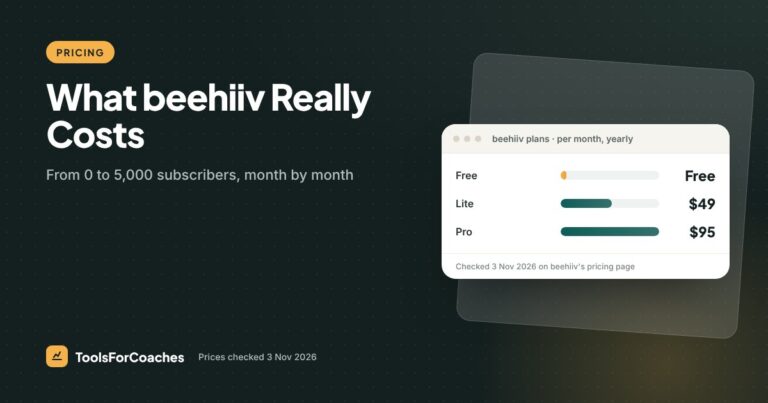
On beehiiv Lite, you pay $49 a month on yearly billing at 1,000 subscribers, and the price climbs with your list. Pro starts at $95 and climbs the same way. We haven’t published beehiiv’s in-between tiers here because the slider moves often. Our beehiiv pricing guide tracks the cost month by month from zero to 5,000 subscribers.
One honest caveat. If a Sunday letter like the one above grows big and carries sponsors, beehiiv’s higher price can pay for itself. Kit has no ad network to offset its bill. So “cheaper” depends on whether your list earns money directly or only through your coaching sales.
Your first week on each tool
A pricing table tells you what you’ll pay. It doesn’t tell you what Monday morning looks like. So here’s what a coach actually builds in week one on each.
Week one on Kit
- Make one sign-up form for your lead magnet. Keep it to an email field and a first name.
- Write a five-email welcome sequence. Email one delivers the freebie. Emails two to four tell your story, share a client win and answer the objection you hear most. Email five asks for a call.
- Add a tag when someone clicks your call link. These are your warm leads. You’ll want them at launch time.
- Connect your checkout (paid plans only) so buyers get tagged and drop out of the sales emails.
That’s a working sales funnel. It feels small, but this is the setup that books calls while you’re coaching.
Week one on beehiiv
- Pick a name and a promise for the newsletter. “One idea for new managers, every Sunday” beats “My newsletter”.
- Write one welcome email that says what’s coming and when.
- Publish your first two issues so the web archive isn’t empty when people land on it.
- Add a short coaching line to the footer of every issue, linking to your booking page.
- Plan your referral reward for when the plan you’re on supports it. A simple PDF or a short call works.
Notice the difference. On Kit, the work is in the funnel. On beehiiv, the work is in the writing. Ask yourself which of those lists you’d actually finish. That’s often your answer.
Can you run both?
Some coaches try. They use beehiiv for the weekly letter and Kit for the sales funnel. On paper it gives you the best of both.
In practice it means two lists that drift apart, two bills, and the constant question of “which tool is this person in?” People unsubscribe from one list and still get emails from the other. Time that should go into writing goes into tidying lists instead. After a few months of that, most setups like this end up back on one tool.
Unless your newsletter is big enough to earn sponsor money on its own, pick one. You’ll write more and fiddle less.
Switching later: how locked in are you?
Not very, on either side. Your subscribers are a list of emails, and both tools let you export them. What doesn’t move cleanly is the logic: Kit’s tags and sequences, or beehiiv’s referral rewards and web archive.
When coaches switch, the pain is almost never the list. It’s rebuilding the welcome series and the rules around it. Budget an afternoon for a simple setup and a few days for a complicated one. If you think you’ll want deep automations within a year, start on Kit and save yourself the rebuild.
Who should skip both Kit and beehiiv
Not every coach needs to settle Kit vs beehiiv at all.
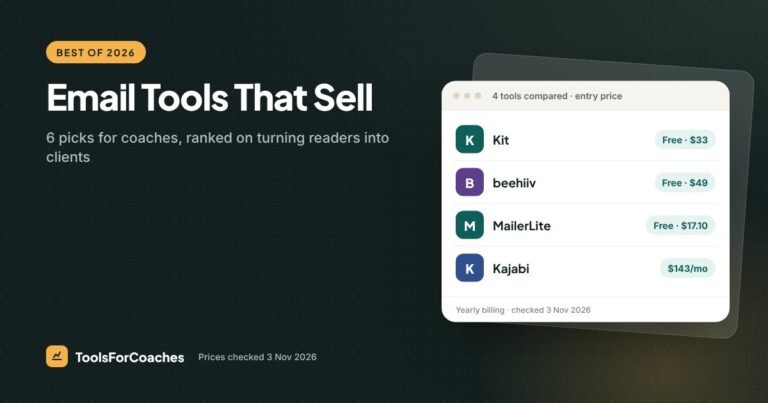
- Coaches already on Kajabi or Podia. Both include email. Kajabi Basic at $143/mo yearly has email marketing built in for up to 2,500 contacts. Paying for Kit on top is often double spending. Use what you have until it hurts.
- Coaches who want the cheapest paid tool for basic sends. Look at MailerLite. Its free plan was cut to 250 subscribers in 2026, but its paid Comfort plan is $17.10 a month at 1,000 subscribers on yearly billing ($19 monthly). See our Kit alternatives for the trade-offs.
- Coaches with no lead magnet and no offer. Neither tool will fix that. Start with the offer.
What I’d do in your shoes
If you sell coaching packages or a group program and email is how you fill them, go with Kit. Start free. Upgrade to Creator the week you need a second sequence or want your checkout to tag buyers. At 1,000 subscribers that’s $33 a month on yearly billing, and the automations will keep sales emails away from people who already bought.
If your newsletter is the thing people love, and coaching is what some readers buy later, go with beehiiv. Start on Free. Move to Lite when its tools are worth more to you than $49 a month.
If you can’t tell which side of Kit vs beehiiv you’re on, you’re probably a seller. Most coaches are. Pick Kit.
Kit vs beehiiv: questions coaches ask
Is Kit or beehiiv better for coaches?
For most coaches, Kit. It’s built to sell through email, with sequences, tags and automations that move a reader towards a call or a program. beehiiv is better if your newsletter itself is the product and you want referral growth or sponsors.
Is beehiiv cheaper than Kit?
Not at the smallest paid tier. At 1,000 subscribers on yearly billing, Kit Creator is $33/mo and beehiiv Lite is $49/mo. On the free plans, Kit holds up to 10,000 subscribers and beehiiv up to 2,500, but Kit’s free plan only allows one automation and one sequence.
Is ConvertKit the same as Kit?
Yes. ConvertKit renamed itself Kit. The product is the same company and the same core tool, with pricing updated in September 2025.
Can I sell coaching sessions with beehiiv?
You can link to your booking or checkout page from any issue, and plenty of coaches do. What beehiiv does less well is react to the sale, like moving buyers out of a sales sequence. If that matters, Kit is the stronger choice.
Can I move from beehiiv to Kit later?
Yes. You can export your subscriber list and import it. You’ll have to rebuild your welcome emails and any automations by hand, so switching is easier while your setup is still simple.
Does Kit’s free plan put branding on my emails?
Yes, the Free plan carries Kit branding. Paid plans remove the free-plan limits, including the single automation and sequence cap and the lack of app integrations.