Here’s something you learn quickly when you help software companies design their plans, and it explains most of the HoneyBook vs Dubsado question. The entry plan is there to look cheap. The feature most buyers came for usually sits one tier up. Both pricing pages follow that shape: neither Starter plan books sessions or runs automations for you.
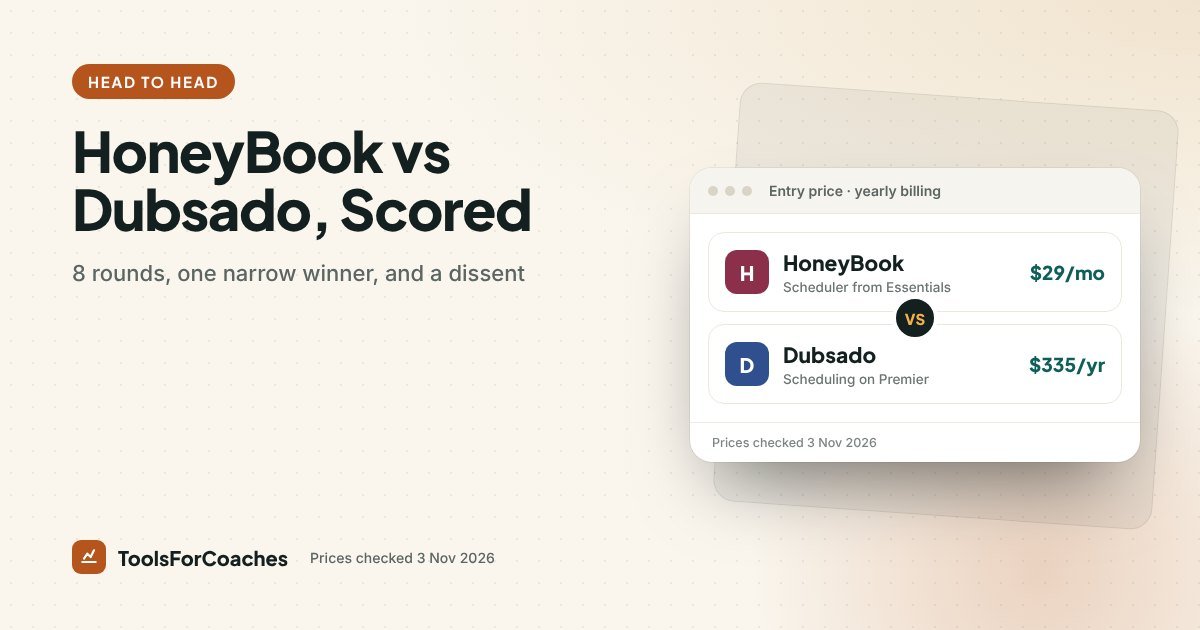
So the fair fight is HoneyBook Essentials against Dubsado Premier, and on yearly billing that’s $588 a year against $525. Close enough that price won’t decide it. What decides it is how you like to work: do you want a tool that’s ready on Saturday, or one you can shape until it fits you exactly?
I’ve scored the two across eight rounds that matter to coaches. Each round gets a score out of 10 and a running tally, so you can see where the lead changes hands. At the end there’s a total, and then a dissent, because the winner is wrong for a real group of people.
Two ways to work, opposite choices
Coaches who ask me to pick between these two tend to fall into one of two camps. Both run 1-to-1 practices of a similar size, and both end up happy with their choice.
The first camp wants to be set up in an afternoon. Send a smart-looking proposal, let the client pick a package, sign and pay in one go, then get back to coaching. Software is a means to an end. That’s HoneyBook’s camp.
The second camp will happily spend most of a month building a system once. After that, every new client gets a welcome form, an intake questionnaire two days later, a prep worksheet before session one, and a check-in form halfway through the package. All of it runs without anyone touching it. That’s Dubsado’s camp.
Neither camp is wrong. That’s the real point of this comparison. The scorecard below just tells you which camp you’re in.
HoneyBook wins by two points for most coaches, because it’s faster to set up and nicer for clients.
- You want to be booking and billing clients this weekend → HoneyBook Essentials
- You only need contracts and invoices, and book sessions elsewhere → either Starter plan ($348 vs $335 a year); neither includes a scheduler or automations
- You run a detailed onboarding process with several forms → Dubsado
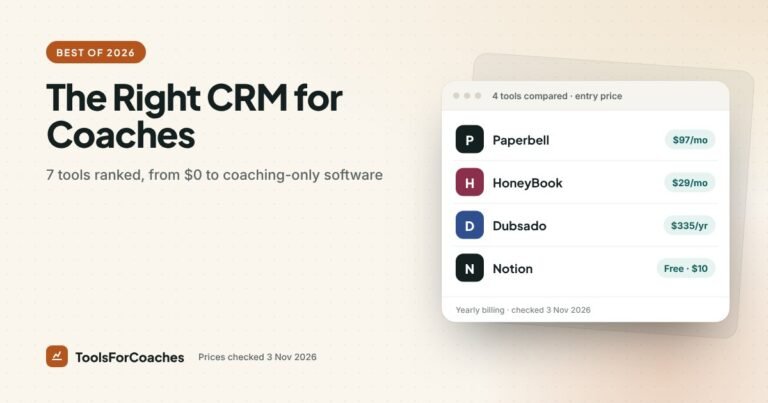
- You sell only coaching packages and want sessions counted automatically → neither; look at Paperbell
Round 1: what each one costs on paper
Here are the plans side by side. All prices from each vendor’s pricing page.
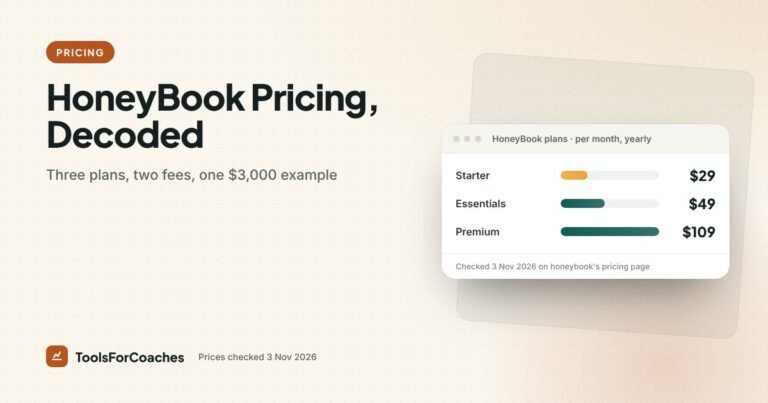
| Plan | Yearly billing | Monthly billing | Per year (yearly) |
|---|---|---|---|
| HoneyBook Starter | $29/mo | $36/mo | $348 |
| HoneyBook Essentials | $49/mo | $59/mo | $588 |
| HoneyBook Premium | $109/mo | $129/mo | $1,308 |
| Dubsado Starter | ~$27.92/mo | $35/mo | $335 |
| Dubsado Premier | ~$43.75/mo | $55/mo | $525 |
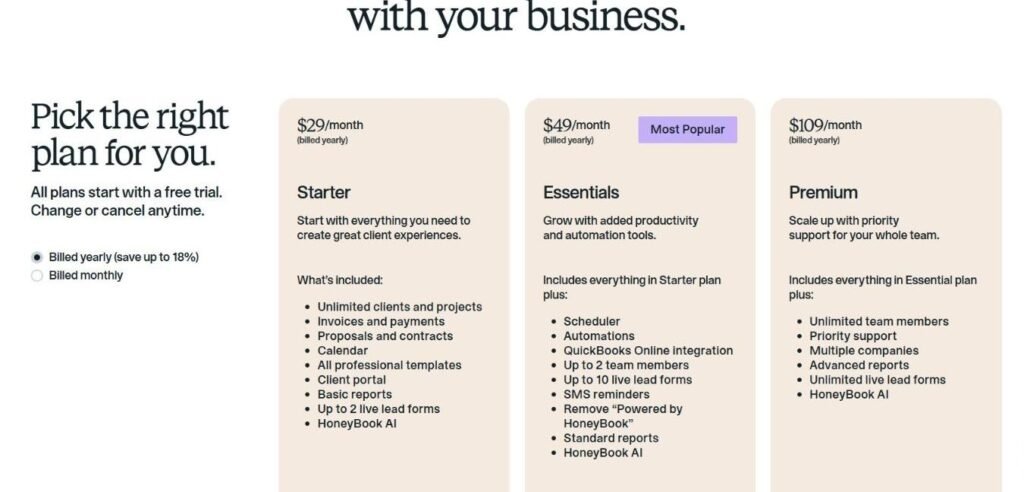

The table hides one big trap. Neither Starter plan books sessions or runs automations. HoneyBook’s Scheduler and Automations start on Essentials. Dubsado’s scheduling and automated workflows are Premier-only. So for most coaches, the fair fight is HoneyBook Essentials against Dubsado Premier.
Dubsado is a touch cheaper at every comparable level. Starter to Starter, it saves you $13 a year. Dubsado Premier against HoneyBook Essentials saves $63 a year. Those aren’t big numbers, but they all point one way.
There’s one more thing in Dubsado’s favour. Both its plans include unlimited clients and 3 users. If you have a VA or a part-time assistant, that’s already covered.
HoneyBook’s Premium plan, at $109 a month on yearly billing, is a big step up. Most solo coaches will never need it.
Round 2: HoneyBook’s fees, and what they really add
This is the round people worry about most, so let’s do the math properly.
HoneyBook charges 2.9% + 25¢ on card payments, and 1.5% on ACH bank transfers. Dubsado connects to your own payment processor, such as Stripe or PayPal. Those charge their own fees, around 2.9% + 30¢ per card sale.
So what does that look like for a coach billing $3,000 a month, say as six $500 payments?
- HoneyBook, all by card: 2.9% of $3,000 is $87, plus 6 × 25¢ = $1.50. Total: $88.50/mo.
- Dubsado with Stripe, all by card: $87, plus 6 × 30¢ = $1.80. Total: about $88.80/mo.
- HoneyBook, all by ACH: 1.5% of $3,000. Total: $45/mo.
That’s the surprise. On cards, HoneyBook’s fee is about the same as paying Stripe directly. The “HoneyBook takes a cut” fear is mostly a myth at this level. And if your clients will pay by bank transfer, HoneyBook’s ACH rate saves you about $43 a month on $3,000 of sales.
I’ve scored this round a tie. HoneyBook’s ACH option is a real bonus, but you’ll need to check whether Dubsado’s processors offer cheaper bank payments in your country too.
Round 3: getting a coaching agreement signed
Both tools send contracts with e-signatures. Both let you save a template, fill in client details automatically and attach the contract to an invoice. For a standard coaching agreement, either one does the job.
The difference is in the selling moment. HoneyBook’s proposals combine your offer, the contract and the invoice into one flow. A client reads what you’re offering, chooses a package, signs and pays without leaving the page. It feels like a single step. For coaches who also sell workshops or corporate days, that flow is a big plus.
Dubsado does the same steps, and lets you control the order and look more closely. But it takes more setup to make them feel as smooth.
All square after three rounds.
Round 4: Dubsado workflows vs HoneyBook automations
This is Dubsado’s home ground.
Dubsado workflows, on Premier, let you string actions together with timing. “When the contract is signed, send the welcome form. Wait two days, send the intake questionnaire. Three days before the first session, email the prep worksheet.” You can branch, pause and add conditions. If your coaching method has a clear onboarding process, you can encode the whole thing.
HoneyBook has automations too, from Essentials up, and they’re easier to build. They cover the common cases well: send a follow-up, remind about a payment, send a questionnaire. But they won’t bend as far. Coaches from the Dubsado camp tend to find HoneyBook lovely, and too fixed to run their exact process.
Quick test: write down every email and form you send a new client in their first month. If it’s more than five items with specific timing, Dubsado will save you hours. If it’s three or fewer, HoneyBook’s automations are plenty.
Round 5: booking sessions
Both tools include scheduling, but not on their entry plans. HoneyBook’s Scheduler starts on Essentials. Dubsado’s scheduling is Premier-only. On either of those plans, you can drop a separate booking app, which saves a monthly bill; Calendly Standard, for example, is $10/seat/mo on yearly billing. On a Starter plan, budget for that booking app on top.
HoneyBook’s scheduler is straightforward and fits naturally into its proposal-to-payment flow. Dubsado’s scheduler is capable and links into its workflows, so a booking can trigger the next step in a sequence. Both handle the basics a coach needs, like setting available hours and sending reminders.
Where both fall short is package tracking. Neither one is built around “6 sessions, 4 left” the way coaching-specific tools are. You can manage it, but you’ll do some of the counting yourself.
I give HoneyBook a slight edge for being simpler to get right first time.
Round 6: what your client sees
Your clients spend time in this tool too. Every contract, invoice and form they open is part of their first impression of you.
HoneyBook wins this round clearly. Its client-facing pages look modern out of the box, work well on a phone, and need little tweaking. The client portal gives each client one place to find their documents and payments.
Dubsado’s client pages can look just as good, and it gives you a client portal too. But “can look” is the key phrase. You’ll spend time on branding and layout to get there. Coaches who skip that step sometimes end up with pages that feel a bit dated.
HoneyBook takes the lead for the first time.
Round 7: time from sign-up to first paid client
For a lot of coaches, this round is the decider.
HoneyBook is quick. Most coaches can connect payments, upload a contract, build one proposal and send it in an afternoon. The defaults are sensible, so you can launch first and polish later.
Dubsado is slower, often much slower. The flexibility in Round 4 comes with a cost: you have to design the system before it runs. Many coaches spend weeks on it. Some hire a Dubsado specialist to build it for them, which adds a one-off cost you should budget for.
Dubsado does help here in one way. Its free trial has no time limit, though you can only use it with up to 3 clients. That means you can build slowly without a countdown clock. Check HoneyBook’s own page for the length of its trial.
Round 8: how far each one bends
The last round is flexibility. Can the tool fit an unusual business, or do you fit the tool?
Dubsado bends further. Custom forms, conditional workflows, detailed branding, three users on every plan. If your practice is unusual, say a mix of 1-to-1 coaching, group programs and retainer clients with different onboarding for each, Dubsado can handle it.
HoneyBook is more opinionated. It has a way it wants you to work, and that way is good for most people. But if you want it to do something it wasn’t designed for, you’ll hit walls sooner.
The final HoneyBook vs Dubsado scorecard
HoneyBook wins 62 to 60. That’s close, and it should be. These are two good tools with different ideas of what “good” means.
Look at where the points come from. HoneyBook’s lead is built on three rounds: client experience, setup time and proposals. Dubsado’s points come from price, workflows and flexibility. So the question isn’t which tool is better. It’s which of those two sets you care about more.
- Ready to use in an afternoon.
- Proposals that combine offer, contract and payment.
- Client pages that look polished without effort.
- ACH bank transfers at 1.5%.
- Slightly cheaper on every comparable plan.
- Branching workflows that run your whole onboarding.
- 3 users and unlimited clients on both plans.
- A free trial with no time limit (up to 3 clients).
The dissent: why Dubsado is the right answer for some of you
A two-point margin means the loser is the winner for a lot of people. Here’s who should ignore the total and pick Dubsado.
If your coaching depends on a set process, the setup-time penalty is paid once. The workflow gain is paid back every single week. A coach taking on four new clients a month, each with five forms and emails in their first month, is doing twenty manual steps a month on a simpler tool. Over a year, that’s hundreds of small jobs Dubsado would do for you.
There’s a money angle too. On yearly billing, Dubsado Premier, its top plan, is $525 and includes 3 users. To reach a comparable level on HoneyBook you’re looking at Essentials at $588, and Premium at $1,308 if you need its extra features. Over two or three years, that gap grows.
So if you scored yourself high on Round 4 and Round 8, and you don’t mind a few weekends of setup, Dubsado is the better tool for you. The total is an average. You’re not average.
Which plan to buy on each side
Picking the tool is half the job. Picking the plan is where coaches overspend. Here’s how I’d think about each one.
HoneyBook Starter ($29/mo yearly)
Who it’s really for: a solo coach who wants contracts, invoices, payments, proposals and a client portal in one place, and already books sessions somewhere else.
The catch: there’s no Scheduler and no Automations on Starter. If clients need to book through HoneyBook, or you want follow-ups sent for you, you need Essentials. Starter plus a $10 Calendly seat is $39 a month, close enough to Essentials that most coaches should just buy Essentials.
HoneyBook Essentials ($49/mo yearly)
Who it’s really for: most solo coaches. It’s the first plan with the Scheduler and Automations, and it adds QuickBooks Online, SMS reminders and up to 2 team members.
The catch: at $588 a year it’s now pricier than Dubsado’s top plan at $525. If automation is why you’re upgrading, compare the two honestly.
HoneyBook Premium ($109/mo yearly)
Who it’s really for: practices with a team and a high volume of clients.
The catch: $1,308 a year is a lot for a solo coach. Few one-person practices need unlimited team members.
Dubsado Starter ($335/yr)
Who it’s really for: a coach who wants Dubsado’s forms, invoicing and payment plans on a budget, with unlimited clients and projects.
The catch: scheduling and automated workflows are Premier-only. Starter is a paperwork plan, not the self-running system Round 4 describes. If workflows are why you chose Dubsado, skip Starter.
Dubsado Premier ($525/yr)
Who it’s really for: the systems-minded coach who’s going to build a full onboarding workflow anyway.
The catch: its value only shows up once you’ve done the setup. Bought and left half-built, it’s just an expensive invoicing tool.
Already on old Dubsado pricing? If you were grandfathered at $20 or $40 after the December 2025 rise, think hard before cancelling. Coming back later means paying today’s rates. Our Dubsado pricing guide covers that decision.
Monthly or yearly billing?
Both tools give you a real discount for paying yearly. Here’s how much you save over twelve months:
- HoneyBook Starter: $36 × 12 = $432 monthly, against $348 yearly. You save $84.
- HoneyBook Essentials: $59 × 12 = $708, against $588. You save $120.
- Dubsado Starter: $35 × 12 = $420, against $335. You save $85.
- Dubsado Premier: $55 × 12 = $660, against $525. You save $135.
My advice: pay monthly for the first two or three months while you make sure the tool fits. Switch to yearly once you’re sure. The few extra dollars are cheap insurance against locking into the wrong tool for a year.
Who should buy neither
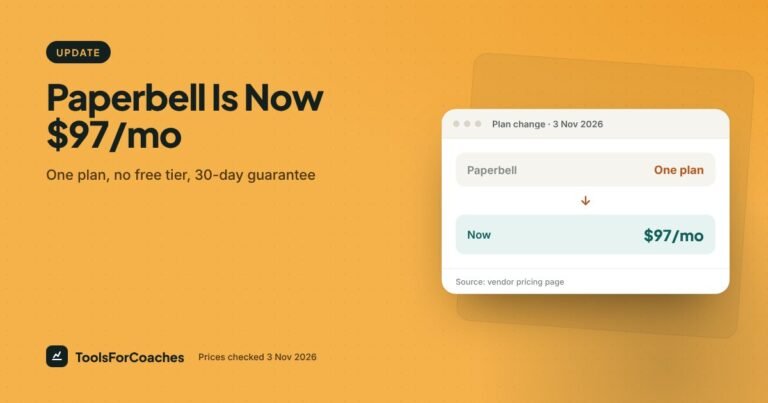
- Coaches who only sell packages. If every sale is “X sessions over Y months”, a coaching-specific tool like Paperbell tracks sessions against what was paid, and handles booking, contracts and payments in one checkout. It costs more than either: $970/yr or $97 monthly, with no free plan. See our Paperbell review.
- Coaches with under about 20 clients and no budget. Notion or Google Sheets can work as a $0 CRM. Pair them with a free booking tool and a payment link. Our Notion for coaches guide shows how.
- Coaches who mostly sell courses. A course platform with built-in checkout may cover what you need already.
What I’d do
If you’re asking me, and you’re a typical solo coach: start with HoneyBook Essentials at $49/mo on yearly billing. It’s the cheapest HoneyBook plan where clients can book with you. You’ll be sending proposals this week. Ask bigger clients to pay by bank transfer to keep fees down. Drop to Starter only if you’re happy booking sessions in another tool.
If you’re the systems person among your peers, the one with a spreadsheet for your spreadsheets, go with Dubsado. Start the free trial, build your workflow with up to 3 real clients, and buy Premier at $525/yr once it runs.
Either way, don’t keep a separate scheduler alongside it. On Essentials or Premier, both tools book sessions. Cancel the extra bill.
Want more depth on either one? See our HoneyBook pricing and Dubsado pricing guides, or the wider best CRM for coaches ranking. You can check HoneyBook’s current plans at honeybook.com/pricing.
HoneyBook vs Dubsado: what coaches ask
Is HoneyBook or Dubsado cheaper?
Dubsado is slightly cheaper on yearly billing. Dubsado Starter is $335/yr, against $348/yr for HoneyBook Starter. Dubsado Premier is $525/yr, against $588/yr for HoneyBook Essentials. Neither Starter plan includes scheduling or automations, so most coaches should compare Premier with Essentials.
Does HoneyBook charge transaction fees?
HoneyBook charges 2.9% + 25¢ on card payments and 1.5% on ACH bank transfers. On cards, that’s about the same as paying a processor like Stripe directly. ACH is the cheaper option for larger invoices.
Is Dubsado hard to set up?
It takes longer than HoneyBook, often weeks rather than an afternoon, because you design your own workflows. Some coaches hire a specialist to build it. Its free trial has no time limit, but is capped at 3 clients.
Can I switch from HoneyBook to Dubsado?
Yes. Client contact details export easily. Download signed contracts and paid invoices as PDFs before you leave. Workflows and automations need to be rebuilt by hand in the new tool.
Did Dubsado raise its prices?
Yes, in December 2025. Starter is now $35/mo monthly or $335/yr, and Premier is $55/mo monthly or $525/yr. Users who were already subscribed kept their old $20 and $40 rates.