$82 for the plan, $33 for email, about $29 in card fees. Add those up and Thinkific pricing for a coach with one course, about 1,000 subscribers and $1,000 a month in sales comes to roughly $144 a month on yearly billing, plus 30¢ a sale. The $82 is the number on the page. The other $62 is the part people forget to budget for.
Nothing is wrong there. Thinkific is honest about the plan. It just doesn’t show the other lines on your bill: the email tool you need beside it, the card processing on every sale, and the cost of picking monthly billing while you make up your mind.
So this guide builds the bill the way it actually arrives, one line at a time. Then it works out when Grow is worth the extra over Start, when yearly beats monthly, and what a full first year costs on four common setups.
Thinkific’s plans now that Basic is gone
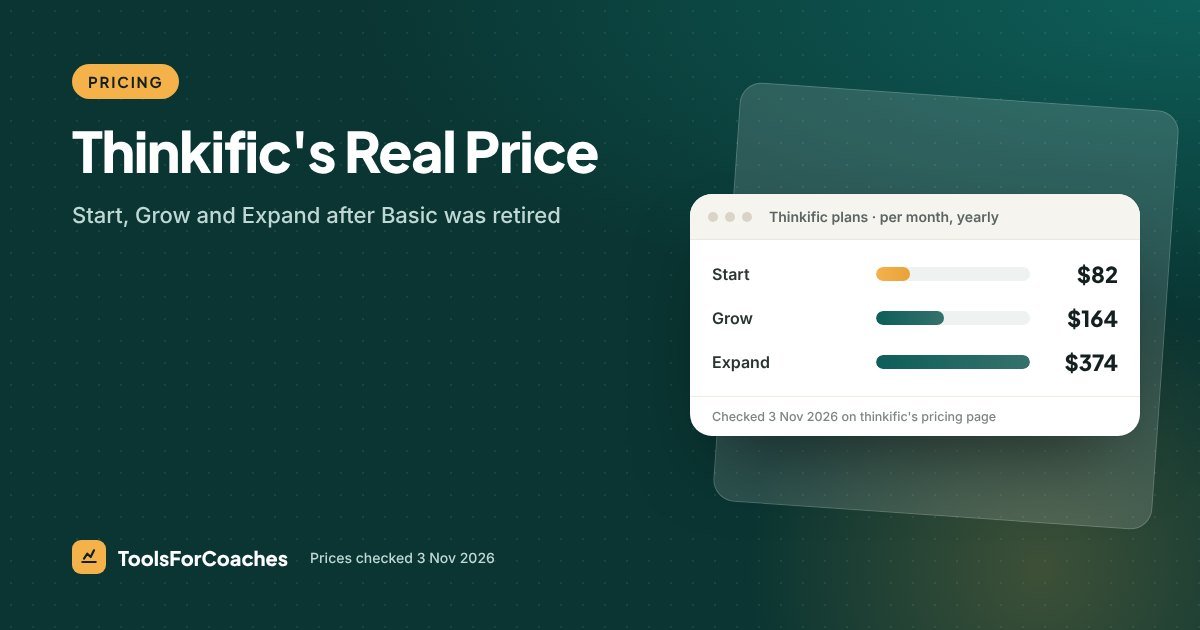
Thinkific raised its prices in October 2026. Then it went further. Thinkific retired its Basic plan in late October 2026; the cheapest plan is now Start. If an older guide quotes you a cheaper Thinkific plan, that’s why. There’s still no free plan, either. You get a free trial, then you pay. Here’s where things stand, from the Thinkific pricing page.
| Plan | Yearly billing | Monthly billing | Transaction fee | What you get |
|---|---|---|---|---|
| Start | $82/mo | $109/mo | 0% | Unlimited courses and students, quizzes, drip, certificates, communities, memberships, bundles |
| Grow | $164/mo | $219/mo | 0% | Thinkific’s “Most Popular” plan; check the page for what it adds |
| Expand | $374/mo | Check Thinkific’s page | 0% | For larger course businesses |
| Thinkific Plus | Custom (talk to sales) | Large organisations | ||
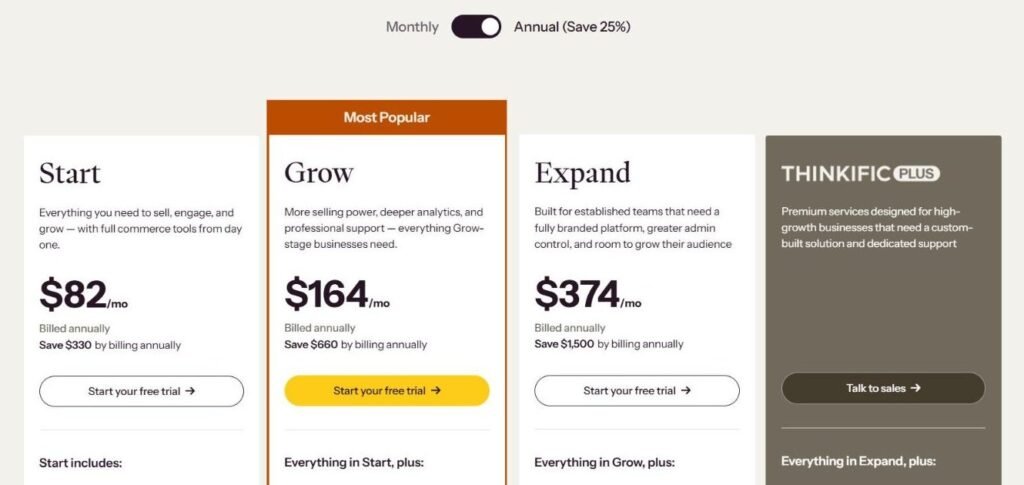
The headline is still good. No plan takes a cut of your sales. Start gives you unlimited courses and Thinkific calls it “full commerce tools from day one”. But it’s no longer a budget plan. Teachable Starter ($29) and Podia Mover ($42) now undercut it, though both take a cut of each sale.
Notice what’s thin on Start’s list: marketing email. Thinkific’s built-in email is basic; most coaches pair it with Kit or MailerLite for newsletters and sales sequences. That’s line two on your bill.
Your real monthly bill, one line at a time
Let’s build the bill for a typical coach: one course, about 1,000 people on their email list, and $1,000 a month in course sales. Yearly billing.
Line 1: the plan
Thinkific Start: $82. This is the number on the pricing page. It covers your course, your students and your checkout.
Line 2: the email tool
Kit Creator at 1,000 subscribers: $33. You need somewhere to send your newsletter and your launch emails. Kit Creator on yearly billing is $33 a month at 1,000 subscribers. It includes automations and app integrations, so new buyers can flow from Thinkific into your list.
There’s a $0 option too. Kit’s Free plan covers up to 10,000 subscribers. The limits are one automation, one sequence, Kit branding and no app integrations. For a first course with one welcome sequence, it works. You’ll move buyers across by hand.
Line 3: card processing
About $29, plus 30¢ per sale. Stripe or PayPal charge roughly 2.9% + 30¢ on each sale. On $1,000 of sales, the percentage part is about $29. Then add 30¢ for every individual sale. This line isn’t Thinkific’s fault. You’d pay it on any platform. But it’s real money and it grows with your sales.
Line 4: Thinkific’s transaction fee
$0. Thinkific takes no platform fee on any plan. This is the line where Thinkific beats plans like Teachable Starter, which takes 7.5%. At $1,000 in sales, that 7.5% would be $75.
The total
| Line | With Kit Creator | With Kit Free plan |
|---|---|---|
| 1. Thinkific Start | $82 | $82 |
| 2. Email tool | $33 | $0 |
| 3. Processing on $1K sales | ~$29 + 30¢/sale | ~$29 + 30¢/sale |
| 4. Platform transaction fee | $0 | $0 |
| Monthly total | ~$144 + 30¢/sale | ~$111 + 30¢/sale |
That’s how $82 becomes a bit over $140. I hear this a lot from coaches a month or two after launch: the plan price was the only number they had budgeted for. Once the lines are laid out, the total makes sense. What stings is the surprise, not the amount.
Read it this way: lines 1 and 2 are your fixed costs. Line 3 is a cost of making a sale. Only lines 1 and 2 should drive your choice of plan.
How the bill changes as sales grow
One nice thing about Thinkific pricing: your fixed costs don’t move when you sell more. Only the processing line grows. Here’s the same coach at three sales levels, on Start with Kit Creator.
| Monthly sales | Plan + email (fixed) | Processing (2.9% part) | Thinkific’s cut |
|---|---|---|---|
| $0 (building) | $115 | $0 | $0 |
| $1,000 | $115 | ~$29 + 30¢/sale | $0 |
| $5,000 | $115 | ~$145 + 30¢/sale | $0 |
At $5,000 a month, processing is the biggest line on your bill. That’s normal, and it’s the same on any platform. What matters is that the “Thinkific’s cut” column stays at zero.
Compare a plan that takes a percentage. At $5,000 in sales, a 7.5% platform fee would be $375 a month on top of processing. That’s why the 0% line is the most valuable thing on Thinkific’s pricing page, even though it’s the least eye-catching.
Your email line will move, though, as your list grows. Kit Creator is $65.83 a month on yearly billing at 5,000 subscribers and $92.50 at 10,000. So a coach with a 5,000-person list on Start has a fixed cost of about $148 a month, not $115. Plan for that before your list takes off.
The same bill on Grow
Now swap Start for Grow, the plan Thinkific labels “Most Popular”. Same coach, same list, same sales.
- Line 1, Thinkific Grow: $164
- Line 2, Kit Creator: $33
- Line 3, processing on $1K: about $29 + 30¢ per sale
- Line 4, platform fee: $0
- Fixed cost (lines 1 + 2): $197 a month
That’s $82 a month more than Start in fixed cost. Over a year, $984. The question is whether Grow earns that back.
Start vs Grow: the break-even
Because Thinkific takes no transaction fee on either plan, the usual “sell more than X and upgrade” maths doesn’t apply. Your sales don’t change the gap. What changes it is what Grow lets you do that Start can’t.
That matters more now than it used to. Start already includes the features coaches most often upgraded for:
- Communities: a space for your students or group program members to talk
- Memberships: recurring access to content, billed on a schedule
- Bundles: several courses sold together at one price
So the break-even is simple. Grow pays for itself once its extra features earn, or save, more than $82 a month after processing. Read Grow’s feature list on the pricing page and tick only the items you’d use this year.
Three ways that happens
- It replaces a paid tool. If something on Grow’s list lets you cancel another subscription that costs more than $82 a month, Grow saves you money outright.
- It opens up a sale you can’t make on Start. If a Grow feature lets you sell something new that clears $82 a month after Stripe’s cut, upgrade.
- It saves real hours. If you run a busy program and a Grow feature takes admin off your plate, value your time honestly. Don’t round it up to justify the jump.
When Grow isn’t worth it
If you sell a few courses and run one group with a community, stay on Start. You’d be paying $984 a year for features you won’t touch. Plenty of coaches upgrade “for later.” Later often doesn’t come.
Monthly vs yearly: the nine-month rule
Yearly billing is cheaper per month. But you pay it up front, and you can’t easily get it back if you change your mind. So when is it worth it?
| Plan | Yearly (paid up front) | Monthly × 12 | Yearly saves | Months of monthly that equal a year |
|---|---|---|---|---|
| Start | $984 | $1,308 | $324 | About 9 |
| Grow | $1,968 | $2,628 | $660 | About 9 |
Here’s the rule. On both plans, nine months of monthly billing costs about the same as a full year paid up front. That matches Thinkific’s own claim that annual billing saves 25%. So:
- If you’re confident you’ll use Thinkific for nine months or more, pay yearly. You’ll save $324 on Start or $660 on Grow.
- If you’re testing an idea and might quit within nine months, pay monthly. You’ll pay more per month but less in total.
What I’d do: pay monthly for the first two or three months while you build and launch. Once real sales come in, switch to yearly. You give up a few dollars of savings in exchange for a cheap exit.
Cash-flow note: yearly billing means paying $984 for Start or $1,968 for Grow on day one. If that’s a stretch right now, monthly billing is a sensible choice, not a mistake.
A 12-month timeline: four ways to run your first year
Here’s how four common setups add up over a year. All include an email tool. Processing is left out, since it’s the same in every row and depends on your sales.
- Setup A: Start yearly + Kit Free plan
- Setup B: Start yearly + Kit Creator yearly
- Setup C: Start monthly + Kit Creator monthly for six months, then upgrade to Grow monthly
- Setup D: Grow yearly + Kit Creator yearly from day one
| Setup | After 3 months | After 6 months | After 9 months | After 12 months |
|---|---|---|---|---|
| A. Start + Kit Free | $246 | $492 | $738 | $984 |
| B. Start + Kit Creator | $345 | $690 | $1,035 | $1,380 |
| C. Monthly, Start then Grow | $444 | $888 | $1,662 | $2,436 |
| D. Grow + Kit Creator | $591 | $1,182 | $1,773 | $2,364 |
What the timeline tells you
Setup A is the cheapest year by far. $984 for unlimited courses, a community and a free email list. If you can live with one automation and moving buyers by hand, start here.
Setup C costs the most. Staying monthly and upgrading halfway through costs $2,436, more than paying for Grow yearly from day one. Flexibility is worth paying for while you test. Paying for it all year adds up.
Setup D only makes sense if you know you need Grow. If a feature on Grow’s list is central to your program from month one, it’s the right pick. If you’re guessing, begin on Start.
For a coach who isn’t sure yet, I’d run a mix: monthly Start for two or three months, then switch to yearly. That keeps you close to Setup B’s total while giving you an early way out.
The costs the page doesn’t show
We’ve covered email and processing. Here are three smaller things to know before you buy.
No free plan, and no cheap plan
Older guides tell you to start free on Thinkific, or on a low-cost Basic plan. Neither is possible now. You get a free trial, then you pay at least $82 a month on yearly billing. Plan to have your first course ready to sell soon after the trial ends, so you’re not paying while you’re still recording.
Payments setup
Thinkific offers its own payments option as well as connections to processors like Stripe and PayPal. Check Thinkific’s payout settings and rates for your region in its help centre before you launch. Whatever you choose, budget around 2.9% + 30¢ per sale as a working estimate.
The jump to Expand
Expand sits above Grow at $374 a month on yearly billing. Its monthly price wasn’t shown when we checked, so look before you plan around it. Above that is Thinkific Plus, with custom pricing through Thinkific’s sales team. Most solo coaches won’t need either in year one.
Thinkific pricing next to its rivals
A price only means something next to the alternatives. Here’s Thinkific’s entry plan against the plans coaches most often compare it with, all on yearly billing.
| Plan | Yearly price | Platform fee | Marketing email | Fixed cost with email |
|---|---|---|---|---|
| Teachable Starter | $29 | 7.5% | Pair a tool | $29–62 + 7.5% |
| Podia Mover | $42 | 5% | Included | $42 + 5% |
| Teachable Builder | $69 | 0% | Pair a tool | $69–102 |
| Thinkific Start | $82 | 0% | Simple built-in; pair a tool | $82–115 |
| Podia Shaker | $84 | 0% | Included | $84 |
| Kajabi Basic | $143 | 0% with Kajabi Payments | Yes, up to 2,500 contacts | $143 |
Here’s the honest read. Thinkific is no longer the cheap option. Teachable Starter and Podia Mover are the cheapest ways in, but both take a cut of every sale. Teachable Builder at $69 is the cheapest 0%-fee plan here, capped at 10 products. Thinkific Start’s case is unlimited courses and students, 0% fees and a mature course builder for $82. Podia Shaker costs $2 more with email built in. Kajabi costs the most, but bundles a website, funnels and community too.
How we checked these numbers
Every price here comes from the vendors’ own pricing pages, checked 3 Nov 2026. We re-check prices monthly. Thinkific’s October 2026 increase, and the retirement of Basic later that month, are why older guides show lower numbers.
I haven’t run a course business on Thinkific myself. My background is on the other side of the pricing page: six years helping SaaS companies shape their plans. That’s why this guide goes line by line. The plan price is designed to be the number you see. The other lines are where the real decision lives.
Is Thinkific worth it at the new price?
For a coach who sells several courses or runs a group program, yes, but for different reasons than before. It’s no longer a budget pick. You’re paying $82 for unlimited courses, 0% fees, a mature course builder and a community on the entry plan. With Kit Creator, you’re at $115 a month. Kajabi Basic, which bundles email for up to 2,500 contacts, is $143. That’s $28 a month, or $336 a year, more than Thinkific plus Kit Creator, and Kajabi caps you at 5 products. On Kit’s Free plan the gap is $61 a month, or $732 a year.
Who should not buy it:
- 1-to-1 coaches without a course. You need scheduling and payments. Paperbell does that for $97 a month, or $970 a year.
- Coaches who want one login for everything. If managing two tools sounds miserable, look at an all-in-one. Our Kajabi vs Thinkific comparison shows when the bundle wins.
- Coaches on a tight budget with one course. Teachable Builder is $69 with 0% fees, $13 less than Start, if 10 products is enough. Teachable Starter at $29 is cheaper still while you sell under about $533 a month. See Thinkific vs Teachable.
What I’d do
- First course, small list: Thinkific Start + Kit’s Free plan. $82. Pay monthly at $109 for the first couple of months, then go yearly.
- First course, want proper automations: Thinkific Start + Kit Creator. $115 on yearly billing.
- Group program or membership: Start already covers it. Look at Grow ($164) only when a specific feature on its list will pay its way.
- Price is the deciding factor: compare Teachable Builder and Podia before you commit.
- Not sure you’ll stick with it for nine months: stay monthly until you are.
For a first course, the sensible path is Start with Kit’s Free plan on monthly billing, then Kit Creator once your list needs real automations, then yearly once sales are steady. Grow can wait until you know it would earn back the extra $82. That’s the right order: prove the need, then pay for it.
For the bigger picture, see our course platform rankings and the full list of Kajabi alternatives, where Thinkific is weighed against the cheaper options.
Thinkific pricing questions
How much does Thinkific cost per month?
Thinkific Start is $82 a month on yearly billing or $109 billed monthly. Grow is $164 yearly or $219 monthly, and Expand is $374 a month on yearly billing. Prices were checked 3 Nov 2026, after Thinkific’s October 2026 increase.
What happened to Thinkific Basic?
Thinkific retired its Basic plan in late October 2026; the cheapest plan is now Start. It’s gone for new customers, so any guide quoting a cheaper Basic price is out of date. Start includes everything coaches used Basic for, plus communities, memberships and bundles.
Does Thinkific have a free plan?
No. Thinkific offers a free trial, then a paid plan. If you want a free way to start your email list alongside it, Kit’s Free plan covers up to 10,000 subscribers.
Does Thinkific take a percentage of sales?
No. Thinkific charges 0% transaction fees on its plans. You’ll still pay card processing, roughly 2.9% + 30¢ per sale through Stripe or PayPal.
Should I pay for Thinkific monthly or yearly?
Pay yearly if you’re sure you’ll stay at least nine months. That’s roughly where monthly billing catches up with the yearly price on both Start and Grow. If you’re still testing, monthly is the safer choice.
Does Thinkific include email marketing?
Thinkific’s built-in email is basic; most coaches pair it with Kit or MailerLite. Kit’s Free plan works to start, and Kit Creator is $33 a month on yearly billing at 1,000 subscribers.