Software companies don’t set plan limits at random. Much of my work is helping SaaS teams decide what goes in each plan, and the entry plan’s limits nearly always sit where a growing customer will bump into them within a year or so. Kajabi pricing in 2026 is a textbook case. Basic’s 2,500-contact cap is the line most coaches will cross first.
The bottom of the ladder moved too. Kajabi changed its pricing in January 2026, and the cheaper Kickstarter plan was retired for new customers. If you’re reading older reviews, that’s why the numbers don’t match.
This guide walks through the Kajabi pricing page as it stands now, plan by plan, in plain English. For each plan I’ll cover what it costs, who it’s really for, and the catch. Then I’ll tell you when Kajabi is worth it and when to leave.
The short version of what changed in January 2026
Three things changed, and only one of them is about price.
- Kickstarter was retired for new customers. It was the cheapest way into Kajabi. If you’re on it already, you keep your rate for now.
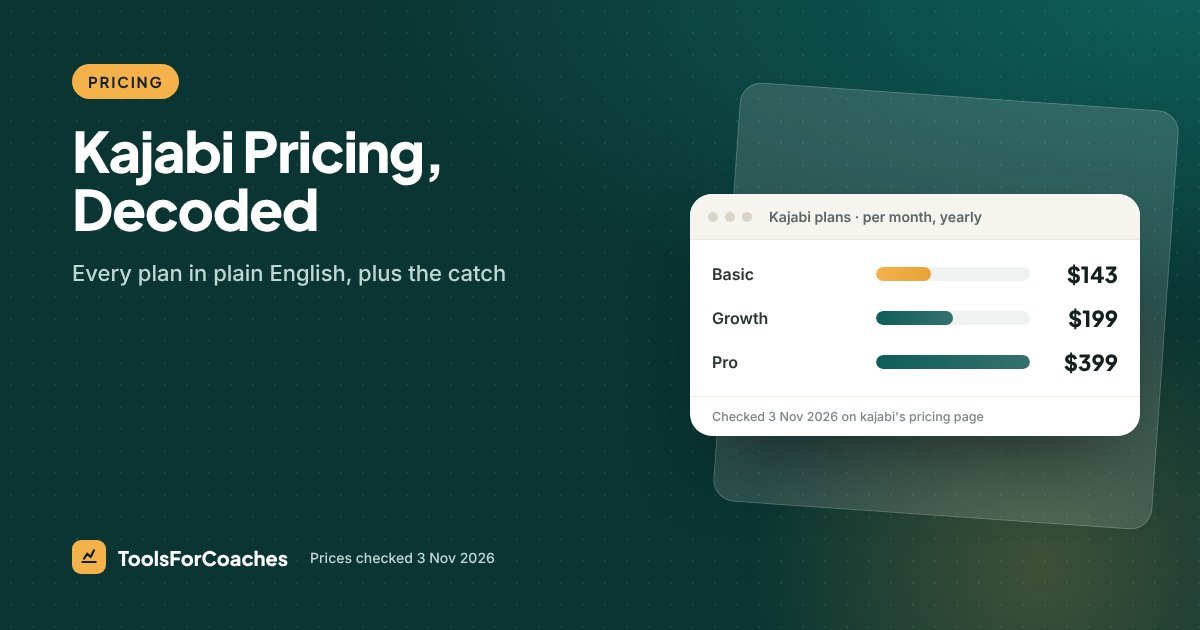
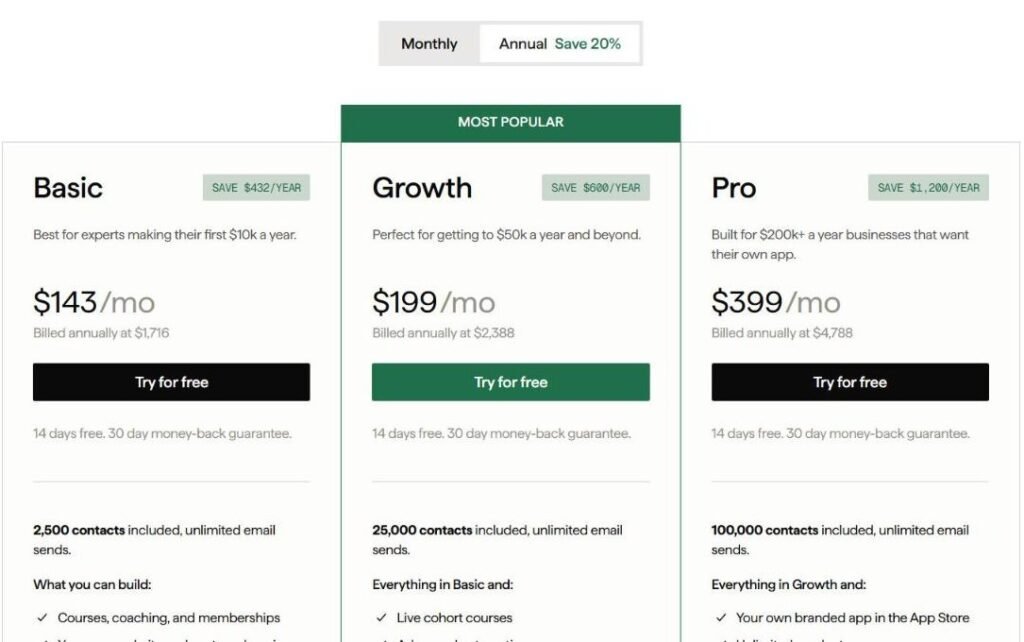
- Basic is now the entry plan. $143 a month on yearly billing, $179 billed monthly.
- The ladder above Basic is Growth, then Pro. Growth is $199 a month on yearly billing. Pro is $399.
In practice, the cheapest way into Kajabi is now $143 a month on yearly billing, or $179 month to month. That changes who Kajabi makes sense for, which is most of what this guide is about.
Kajabi Basic is worth $143 only if it replaces your website, email tool and community; otherwise you’re paying for features you won’t open.
- Running site, list, course and community in four separate tools → Basic can cost less than your stack
- Grandfathered Kickstarter → keep it
- One course and a website you already like → Kajabi is expensive for what you’ll use
How to read the Kajabi pricing page
Before the plans, three terms on the page that trip people up.
“Billed annually” vs “billed monthly”
The big number Kajabi shows first is usually the yearly price, divided into months. On Basic that’s $143. You pay it up front for the year. If you pay month to month, Basic is $179. That’s $36 more every month, or $432 over a year.
Monthly billing isn’t a bad choice. It’s a price you pay for being able to leave. If you’re not sure Kajabi is right for you, pay monthly for a couple of months, then switch.
“0% transaction fees”
This means there’s no Kajabi transaction fee when you use Kajabi Payments, its built-in checkout. It’s a real advantage over plans like Teachable Starter, which takes 7.5%. If you plan to connect your own Stripe account instead, check the surcharge before you sign up.
It doesn’t mean selling is free. Stripe or PayPal still charge about 2.9% + 30¢ on each sale. That’s true on every course platform, so it isn’t a Kajabi cost as such. Just don’t expect a $100 sale to land as $100.
“Products”
Kajabi’s limits are written in products, not courses. Basic includes 5. Check the plan page for exactly what counts as one. Basic also caps your list at 2,500 contacts. For most solo coaches, that’s the number to watch.
Kajabi Basic: $143 a month
This is the plan almost every new customer will start on.
| What you get | Basic |
|---|---|
| Yearly billing | $143/mo |
| Monthly billing | $179/mo |
| Kajabi transaction fee | 0% with Kajabi Payments |
| Products | 5 |
| Contacts | 2,500 |
| Websites | 1 |
| Admin users | 2 |
| Email marketing | Included |
| Funnels | Included |
| Community | Included |
In plain English
Basic is a full online business in one login. You can build a website, email up to 2,500 contacts with newsletters and sequences, sell up to five products, and run a community for your members. No other tool needed for the core jobs.
Who Basic is really for
A coach who would otherwise pay for a website builder, an email tool and a course platform with a community. If you’d be stacking three or four subscriptions, Basic replaces them in one bill. It’s also right for coaches who just don’t want to manage tools. That’s a fair reason to pay more.
Specifically, Basic is enough for you if:
- You sell five or fewer things: say, a signature course, a group program, a membership and a mini-course
- Your email list is under 2,500 contacts, and not growing fast
- You need one website, not several
- You want your email list and your buyers in the same place
The catch
2,500 contacts is the real limit. Five products is enough for most solo coaches. One course, a mini-course, a workshop replay and a group program is four, and that still fits. The contact cap bites sooner. A couple of good lead magnets can push a list past 2,500 within a year. Then you’re on Growth at $199.
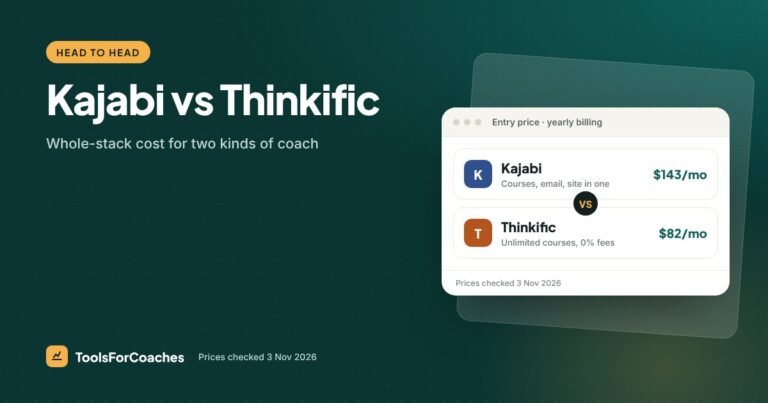
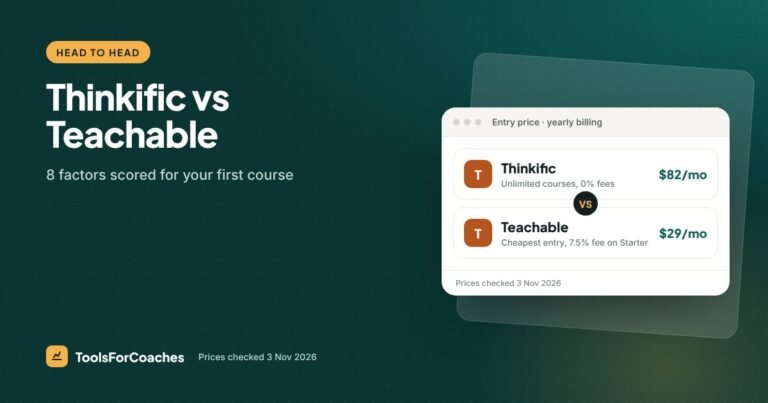
It’s a lot of money for a course alone. If you already have a website you like and an email list you’re happy with, you’re paying $143 for a course host. Teachable Builder does that job for $69, and Thinkific Start does it for $82 with unlimited courses. We price this out in Kajabi vs Thinkific.
Quick test: add up what you pay today for a website, email tool, course platform and any community app. If it’s more than $143 a month, Kajabi Basic may save you money. If it’s less, it won’t. If your list is over 2,500 contacts, use Growth’s $199 as your number instead.
Kajabi Growth: the middle plan
Growth sits above Basic. It’s $199 a month on yearly billing, or $249 billed monthly. You get 50 products, 25,000 contacts and 11 admin users, still with 1 website. Check Kajabi’s pricing page before you plan a budget around it.
In plain English
Growth is for when Basic’s limits start to pinch. As I said at the top, tiers like this are built around one or two limits that a growing business hits first. On Kajabi, those are products and contacts. With 5 products on Basic, most solo coaches hit the 2,500-contact cap first.
Who Growth is really for
A coach with a proven business who has outgrown Basic: more than 2,500 contacts, or more than five products. You have a signature course that sells, a group program that fills, and a list that keeps growing. You’re making enough that the extra $56 a month is a small share of revenue.
The catch
You’re paying more for room you might not fill. Before you upgrade, check which limit you’ve hit. If it’s products, ask whether two could be combined. A course and its bonus workshop could be one product. If it’s contacts, clear out people who haven’t opened an email in months. Either step can keep you on Basic for longer. It’s common to upgrade simply because a sixth product idea came along, then never launch it.
Kajabi Pro: the top plan
Pro is Kajabi’s highest plan. It’s $399 a month on yearly billing, or $499 billed monthly. You get unlimited products, 100,000 contacts, 3 websites and 26 admin users.
In plain English
Pro is for a coaching business that’s run like a small company. Several products, maybe several websites, maybe a team helping out. The jump is about scale, not about features a solo coach needs early on.
Who Pro is really for
An established coach with a large catalogue, more than one brand, or staff who need access. If you’re a solo coach with a handful of offers, you almost certainly don’t need it.
The catch
It’s easy to buy Pro “to be safe.” Don’t. On a yearly plan you’re locked in for twelve months. Start lower and upgrade the day you hit a real limit.
Kickstarter: the cheaper plan you can’t buy
Kickstarter was Kajabi’s old, cheaper entry plan. It was retired for new customers in January 2026.
If you’re on it now
Keep it. Kajabi says existing Kickstarter customers keep their rate for now. Your old rate gets you an all-in-one platform for less than most coaches would pay for separate tools. There’s no cheaper way to get the same bundle today.
The catch
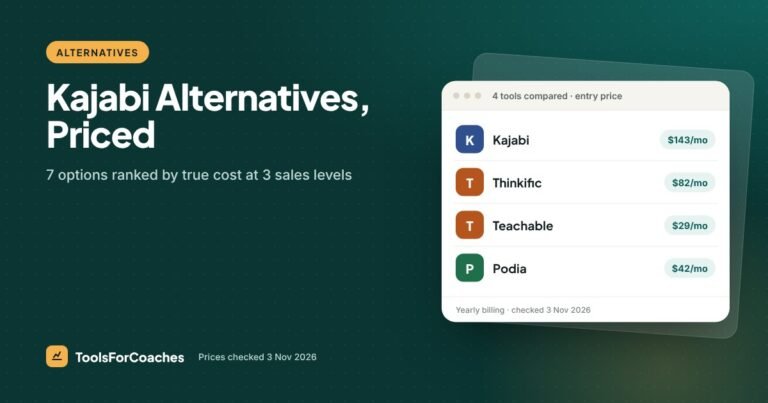
“For now” is not “forever.” Read every email Kajabi sends about your plan. If they ever end the grandfathered rate, you’ll want a plan ready. Our guide to Kajabi alternatives ranks the options by true cost, so you’re not starting from scratch if it happens.
Also, if you cancel or change plans, you probably can’t get Kickstarter back. Think hard before you touch it.
Kajabi cost over a year, side by side
Here’s what Basic actually costs over twelve months, next to three common setups coaches compare it with.
| Setup | Per month | Per year | What’s covered |
|---|---|---|---|
| Teachable Builder + Kit Free | $69 | $828 | Course + free email |
| Thinkific Start + Kit Free | $82 | $984 | Unlimited courses + free email |
| Thinkific Start + Kit Creator | $115 | $1,380 | Unlimited courses + paid email |
| Kajabi Basic, yearly | $143 | $1,716 | All-in-one |
| Kajabi Basic, monthly | $179 | $2,148 | All-in-one |
| Kajabi Growth, yearly (over 2,500 contacts) | $199 | $2,388 | All-in-one |
On yearly billing, Kajabi Basic costs $336 a year more than Thinkific Start with Kit Creator, $732 more than Thinkific Start on Kit’s Free plan, and $888 more than Teachable Builder with Kit Free. That’s the price of having everything in one place. On monthly billing the Thinkific-plus-Kit-Creator gap is $31 a month ($148 against $179). Once your list passes 2,500 contacts, the Kajabi line becomes Growth, and the gap grows. For some coaches it’s worth it. For many it isn’t.
What the Kajabi pricing page doesn’t show
The plan price is the biggest number, but it isn’t the whole Kajabi cost. Three more lines belong in your budget.
Payment processing on every sale
Kajabi’s own fee is zero when you use Kajabi Payments. Card processing still takes about 2.9% + 30¢ per sale. For every $1,000 you sell, that’s about $29, plus 30¢ for each sale. You’d pay this on any platform, so it shouldn’t push you away from Kajabi. It should stop you thinking your margin is 100%.
The tools Kajabi doesn’t replace
Most coaches still need a scheduling tool for discovery calls and 1-to-1 sessions. Kajabi isn’t built as a booking app. So budget for one alongside it. Calendly has a free plan, but collecting payment at booking needs its paid Standard plan at $10 a seat a month on yearly billing. Cal.com’s free plan includes built-in payments as of October 2026. Our scheduling software guide covers the options.
If you send contracts or invoices for coaching packages, that’s often another tool too. Add these up before you decide Kajabi is your “one tool.”
The upgrade you didn’t plan for
The 2,500-contact cap on Basic is the number most likely to raise your bill in year two. Before you sign up for a year, look at your list size and how fast it’s growing. If you’ll pass 2,500 within twelve months, budget for Growth at $199 from the start. Then do the same check for products. More than five items on your plan for the year means Growth too, or merging products.
The Kajabi free trial: how to use it well
Kajabi offers a 14-day free trial, so you can try the platform before paying. You’ll need a card to start it, and there’s a 30-day money-back guarantee after that. Fourteen days goes fast, so plan what you’ll test before you sign up.
A trial is only useful if you test the right things. Here’s what I’d do in the first few days:
- Import your email list and send yourself a test newsletter. Email is half of what you’re paying for, so test it first.
- Build one real product, not a dummy. Upload actual lessons.
- Set up one funnel: an opt-in page, a short email sequence and a sales page.
- Buy your own product with a real card, then refund yourself.
- Count your products and contacts. Look at your plan for the year and see if five products and 2,500 contacts are enough.
Set a reminder two days before the trial ends. Decide yearly or monthly on purpose, not by default.
How Kajabi pricing compares with other all-in-ones
Kajabi isn’t the only platform that bundles courses and email. Podia does too, at a lower price, with more room for products.
| Plan | Yearly price | Transaction fee | Products |
|---|---|---|---|
| Podia Mover | $42/mo | 5% | 50 |
| Podia Shaker | $84/mo | 0% | 150 |
| Kajabi Basic | $143/mo | 0% with Kajabi Payments | 5 (2,500 contacts) |
| Podia Earthquaker | $150/mo | 0% | Unlimited |
If your list is small, Podia Shaker at $84 is a cheaper way to get the all-in-one feel, with 150 products against Kajabi Basic’s 5. The open question is email. Check the subscriber allowance on Podia’s page against your list size; Kajabi Basic’s 2,500 contacts is a known number. Past 2,500, compare against Growth at $199. Our Kajabi vs Podia breakdown goes plan by plan.
Is Kajabi worth it? A view from the other side
Here’s a second thing the vendor side teaches you. The entry plan of an all-in-one tool is priced for the customer who uses all of it. Everyone else subsidises them.
So who is that full-use customer? She has about 2,000 people on her list, and Kajabi Basic runs her website, her weekly email, two courses and a small paid community. Her only other tool is a scheduling app.
Now price what it would cost her to leave. A website builder, a paid email plan for her list size, a course platform with communities, and probably Zapier to connect them. It comes to more than $143 a month. And it means four logins instead of one.
She should stay. One thing I’d flag: at 2,000 people she’s close to Basic’s 2,500-contact cap. A reminder to clean her list every quarter stops growth pushing her onto Growth by accident.
Staying is the right answer for someone who uses the whole bundle. The coaches who should leave are the ones who use a slice of it. You can see which one you are in about ten minutes.
When to stay on Kajabi, and when to leave
Stay if
- You’re on grandfathered Kickstarter
- You use Kajabi for your website, email, courses and community
- You sell five products or fewer, your list is under 2,500 contacts, and that’s not likely to change soon
- Replacing it would mean paying for three or more separate tools
Leave if
- Your website lives somewhere else and you like it there
- You barely use Kajabi’s email or community
- You sell one course and want to keep costs low
- You keep bumping into Basic’s 5-product or 2,500-contact limit and don’t want to pay $199 for Growth
Don’t start on Kajabi if
- You’re a 1-to-1 coach with no course yet. You need scheduling and payments first. Paperbell does that for $970 a year, or $97 billed monthly.
- You want to test whether anyone will buy a course. $143 a month is a lot to spend on a test. A cheaper platform tells you the same thing.
What I’d do, by coach type
- New coach, first course, no website yet: Kajabi Basic can make sense, because it covers your site too. Pay monthly at $179 for two or three months, then go yearly at $143 if you’re staying.
- Coach with a website and list you like: skip Kajabi. Use Teachable Builder at $69 with Kit’s Free plan, or Thinkific Start at $82 if you want unlimited courses.
- Group-program coach running four separate tools: price your stack. If it’s over $143 (or $199 if your list is past 2,500), Kajabi is likely cheaper and simpler.
- Established coach with more than five products or 2,500 contacts: look at Growth at $199, but first check if you can merge products or clean your list to stay on Basic.
- Kickstarter customer: do nothing. Keep your grandfathered rate and watch your inbox.
If you came here hoping for the old Kickstarter price, $143 is a different decision. Kickstarter was easy to say yes to without much thought. At $143, it’s worth stopping to check. With a website you already like, a course platform plus Kit is usually the better call.
For a broader look at what else is out there, see our best course platforms for coaches.
Kajabi pricing FAQ
How much is Kajabi per month?
Kajabi Basic costs $143 a month on yearly billing or $179 a month billed monthly, checked 3 Nov 2026. Growth is $199 a month yearly ($249 monthly) and Pro is $399 ($499 monthly). Kajabi doesn’t take a transaction fee on top when you use Kajabi Payments, but card processing costs about 2.9% + 30¢ per sale.
What happened to the Kajabi Kickstarter plan?
Kajabi retired the cheaper Kickstarter plan for new customers in its January 2026 pricing overhaul. Existing Kickstarter customers keep their rate for now. New customers start on Basic.
Does Kajabi charge transaction fees?
No Kajabi transaction fee when you use Kajabi Payments. You’ll still pay standard payment processing to Stripe or PayPal, roughly 2.9% + 30¢ per sale, as you would on any platform.
Is Kajabi cheaper if I pay yearly?
Yes. Kajabi Basic is $143 a month on yearly billing against $179 billed monthly. That saves $36 a month, or $432 over a year.
How many products can I sell on Kajabi Basic?
Basic includes 5 products, 2,500 contacts, 1 website and 2 admin users. Check Kajabi’s plan page for exactly what counts as a product. If you need more, Growth gives you 50 products and Pro has no product limit.
Is Kajabi worth it for a new coach?
Only if it replaces several tools you’d otherwise pay for, like a website builder and an email platform. If you just need a place to host one course, a platform like Teachable Builder at $69 a month or Thinkific Start at $82 is much cheaper.